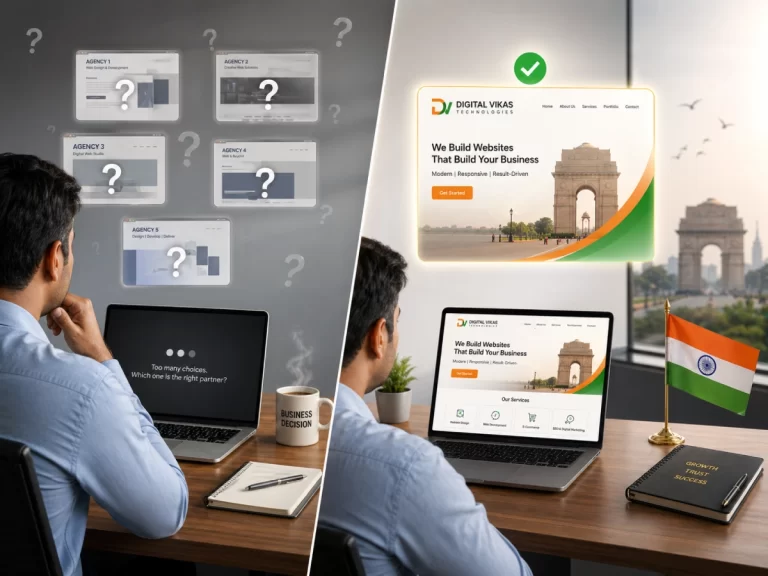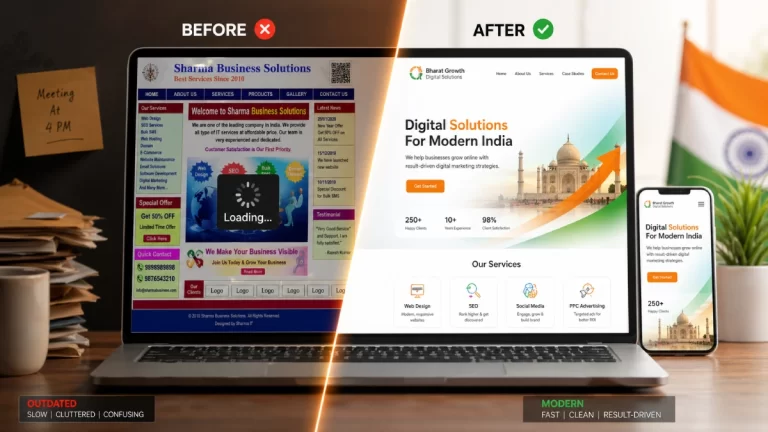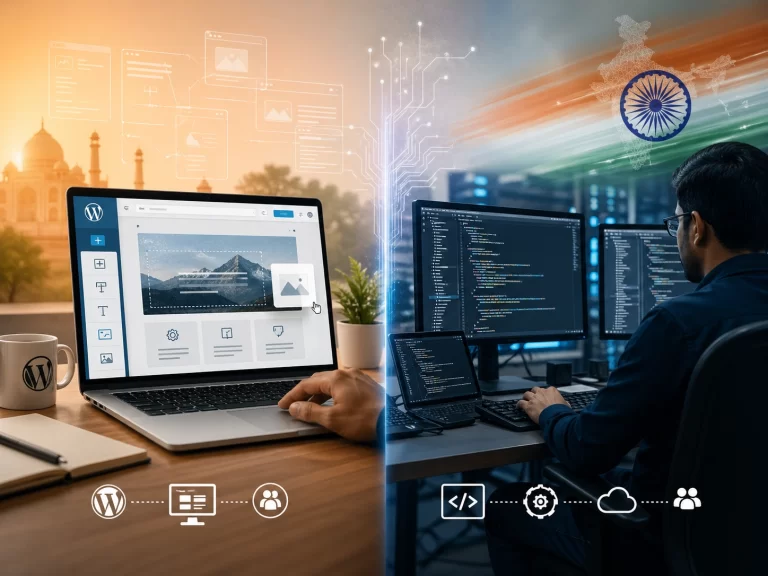

Custom website development gives Indian small businesses a unique online identity, better performance, and full control over features – unlike generic templates. This guide covers costs, benefits, the development process, how to choose the right agency or freelancer in India, and everything a beginner needs to know before investing in a custom website.
Table of Contents
Why Your Small Business Needs a Website Right Now
Over 750 million Indians are now online. TRAI Internet Report 2025
That number is only going up. And guess what most of them do before buying a product or hiring a service? They Google it.
If your business doesn’t have a website, you simply don’t exist for those people. A Facebook page or an Instagram handle helps – but it’s not enough. You don’t own that platform. One algorithm change and your reach drops to zero.
A website? That’s yours. Forever.
For small businesses in India – whether you run a boutique in Jaipur, a CA firm in Pune, a restaurant in Bangalore, or a manufacturing unit in Surat – having a website is no longer optional. It’s the first step toward building real credibility.
Custom Website vs. Template Website – What’s the Difference?
This is where most beginners get confused. Let’s break it down simply.
A template website is like renting a flat that someone else designed. You can move some furniture around, paint a wall, but the structure stays the same. Platforms like Wix, Squarespace, or even basic WordPress themes fall into this category.
A custom website is like building your own house from scratch. Every room, every wall, every corner – designed exactly the way you need it.
| Feature | Template Website | Custom Website |
| Design Uniqueness | Generic, used by thousands | 100% unique to your brand |
| Flexibility | Limited | Unlimited |
| Performance | Average | Optimized for speed |
| Scalability | Hard to scale | Built to grow with you |
| SEO Control | Basic | Full control |
| Cost | Low (₹0–₹10,000) | Medium to High (₹15,000–₹5,00,000+) |
| Ownership | Platform-dependent | Fully yours |
| Load Time | Often slow due to bloated code | Fast, clean code |
The bottom line? If you’re serious about your business, a custom website is the better long-term investment.
Key Benefits of Custom Website Development for Indian Small Businesses
1. Stands Out in a Crowded Market
Look at your competitors. Many of them are using the same Wix template or the same ₹500 WordPress theme. A custom website immediately sets you apart. Your brand has its own identity, its own colors, its own personality online.
2. Designed for Your Specific Customers
A saree shop in Varanasi has different customers than a software startup in Hyderabad. Custom development means your website is built around your audience – their language preferences, their browsing behavior, their trust signals.
3. Faster Load Speed = More Sales
Did you know a 1-second delay in page load time can reduce conversions by 7%? [External Authority Link Placeholder – Google/Deloitte Mobile Speed Study]
Custom websites have clean, lean code. No unnecessary plugins. No bloated themes. Result? Pages load faster, users stay longer, and you rank higher on Google.
4. Better SEO (Search Engine Optimization)
Google doesn’t just rank good content. It ranks technically sound websites too. Custom websites give developers full control over:
- URL structure
- Schema markup
- Core Web Vitals
- Page speed optimization
- Mobile responsiveness
All of this helps your website rank higher in local Google searches – like “best accountant in Delhi” or “wholesale fabric supplier Mumbai.”
5. Scales as Your Business Grows
Starting with a basic 5-page website today? Fine. In two years, you might need an online store, a customer login portal, or an appointment booking system. A custom website can grow with you without breaking anything.
6. Security You Can Control
Template platforms get hacked. A lot. In 2024, thousands of WordPress sites running popular templates were compromised due to plugin vulnerabilities. [External Authority Link Placeholder – Wordfence Security Report]
With a custom-built site, your developer can implement security measures specific to your needs – whether that’s payment gateway security, customer data protection, or just basic firewall rules.
What Does a Custom Website Include?
When you hire someone for custom website development, here’s what should typically be included:
- UI/UX Design – Mockups and wireframes of every page before coding begins
- Responsive Design – Works perfectly on mobile, tablet, and desktop
- CMS Integration – Ability to update your own content (blog, products, pages)
- Contact Forms & Lead Capture
- Google Analytics & Search Console Setup
- Basic On-Page SEO – Meta titles, descriptions, alt tags
- Social Media Integration
- Fast Hosting Setup
- SSL Certificate (the little padlock in the browser – essential for trust and SEO)
- 3–6 Months of Support (varies by agency)
Always confirm what’s included in writing before signing any contract.
Custom Website Development Cost in India
Here’s the honest picture. Pricing varies widely – based on complexity, the developer’s experience, and your city.
| Website Type | Features | Approximate Cost (INR) |
| Basic Business Website | 5–8 pages, contact form, responsive | ₹15,000 – ₹40,000 |
| Professional Service Website | Blog, testimonials, portfolio, SEO ready | ₹40,000 – ₹1,00,000 |
| E-Commerce Website | Product catalog, cart, payment gateway | ₹80,000 – ₹3,00,000 |
| Web Application / Custom Portal | Login system, dashboards, APIs | ₹2,00,000 – ₹10,00,000+ |
| Enterprise Website | Large-scale, CRM integration, multi-language | ₹5,00,000+ |
Pro Tip: Don’t just go with the cheapest option. A poorly built website costs more to fix later than it would have to build it right the first time. Focus on value, not just price.
Freelancer vs. Agency – Which Is Better for Small Businesses?
| Factor | Freelancer | Agency |
| Cost | Lower (₹10,000–₹80,000) | Higher (₹50,000–₹5,00,000+) |
| Communication | Direct, personal | Structured, through account manager |
| Turnaround Time | Faster for small projects | Better for large, complex projects |
| Reliability | Varies greatly | Generally more accountable |
| Post-Launch Support | Depends on the person | Usually included in contract |
For most small businesses in India, a skilled freelancer or a small boutique agency offers the best balance of quality and cost.
How to Choose the Right Web Developer or Agency in India
This is where many business owners go wrong. Here are the key things to look for:
Check Their Portfolio
Have they built websites for businesses similar to yours? Look at real live URLs, not just screenshots.
Ask for References
Speak to 2–3 of their previous clients. Ask: Did they deliver on time? Was the final product what was promised? How was support after launch?
Understand the Technology They Use
Ask what tech stack they work with. Common good choices for Indian small businesses:
- WordPress + Custom Theme (cost-effective, easy to manage)
- React.js / Next.js (fast, modern, great for scalability)
- Laravel / Node.js (for web apps and portals)
Avoid developers who only know one outdated framework or refuse to explain their tech choices.
Get Everything in Writing
A proper contract should include:
- Project scope (exactly what pages, features are being built)
- Timeline with milestones
- Payment terms (avoid paying 100% upfront)
- Ownership of code and domain
- Post-launch support period
Avoid These Red Flags
- No portfolio or only fake screenshots
- Promises unrealistically low prices (₹2,000 for a “full website”)
- Cannot explain basic concepts like SEO or mobile responsiveness
- Asks for full payment before starting
- Uses Wix/template but calls it “custom development”
Step-by-Step: How Custom Website Development Works
Understanding the process helps you be a better client. Here’s what happens from start to finish:
Step 1: Discovery & Requirement Gathering
You meet with the developer/agency, discuss your goals, target audience, competitors, and features needed.
Step 2: Planning & Sitemap
A sitemap is created – essentially an outline of all your website pages and how they connect to each other.
Step 3: UI/UX Design (Wireframes & Mockups)
Before any code is written, you see exactly how each page will look. You review and approve the design.
Step 4: Development
The actual coding begins. Front-end (what users see) and back-end (database, server logic) are built.
Step 5: Content Integration
Your text, images, videos, and other content go live on the pages.
Step 6: Testing
The website is tested on different browsers (Chrome, Safari, Firefox), devices (Android, iPhone, laptop), and for speed, broken links, and form functionality.
Step 7: Launch
The site goes live on your domain. DNS settings are updated, SSL is activated.
Step 8: Post-Launch Support
Bug fixes, minor changes, and performance monitoring happen in this phase.A typical small business website takes 4–8 weeks from kickoff to launch. Complex projects take longer.
Common Mistakes Small Business Owners Make
Mistake #1: Choosing price over quality A ₹5,000 website that loads slowly, looks broken on mobile, and ranks nowhere on Google helps no one.
Mistake #2: Not planning the content in advance Many projects get delayed because the client doesn’t have their photos, text, or logo ready when development starts. Prepare your content before the project begins.
Mistake #3: Ignoring mobile optimization Over 70% of internet traffic in India comes from mobile devices. If your website looks terrible on a phone, you’re losing customers every single day.
Mistake #4: Thinking launch = done A website needs regular updates – new content, security patches, performance tuning. Budget for ongoing maintenance, not just the one-time build.
Mistake #5: Not owning your domain and hosting Always register the domain in your own name. Never let an agency or freelancer hold ownership of your domain. If the relationship sours, you could lose your website address.
Top Technologies Used for Custom Web Development in India
| Technology | Best For | Why Indian Devs Love It |
| WordPress (Custom Theme) | Small business sites, blogs | Huge community, easy client handover |
| React.js / Next.js | Startups, modern websites | Fast, component-based, SEO-friendly |
| Laravel (PHP) | Custom portals, CRMs | Robust, widely used in India |
| Node.js | Real-time apps, scalable backends | Fast, JavaScript full-stack |
| Flutter Web | Cross-platform (web + app) | One codebase, many platforms |
| Shopify (Custom Dev) | E-commerce | Reliable, payment-ready |
India has a massive pool of talented developers in cities like Bengaluru, Hyderabad, Pune, Chennai, Delhi NCR, and Jaipur. You can find excellent talent both locally and on platforms like Upwork, Toptal, or LinkedIn.
Conclusion
A custom website is not a luxury for Indian small businesses – it’s a smart business investment. It gives you complete ownership, better Google rankings, faster load speeds, and a professional online presence that actually converts visitors into customers.
Yes, it costs more than a template site. But it pays back many times over.
Start small if needed – a 5-page custom website is infinitely better than a cluttered template with borrowed design. Get clear on your goals, find a trustworthy developer, and take your business online the right way.
The best time to build your website was yesterday. The second best time is today.
FAQs
1. How much does a custom website cost for a small business in India?
A basic custom website for a small business in India typically costs between ₹15,000 and ₹1,00,000, depending on the number of pages, features, and the experience of the developer or agency. E-commerce websites cost more – usually starting from ₹80,000.
2. How long does it take to build a custom website?
A simple 5–8 page business website usually takes 4 to 6 weeks to design, build, and launch. More complex websites with portals, e-commerce functionality, or custom integrations can take 3–6 months.
3. Do I need a custom website or will a template like Wix or WordPress theme work?
For early-stage or very small businesses, a template can work as a starting point. But once you’re serious about growth, SEO, and brand identity, a custom website gives you far more control, speed, and flexibility that templates simply can’t match.
4. What should I look for when hiring a web developer in India?
Look for a solid portfolio with live website examples, clear communication, a proper written contract, and genuine knowledge of SEO and mobile responsiveness. Avoid anyone who can’t explain what they’re building or asks for 100% payment upfront.
5. Can I update my custom website myself after it’s built?
Yes – most custom websites built today include a Content Management System (CMS) like WordPress, which lets you update text, images, blogs, and products on your own without needing a developer. Make sure to ask for this feature and a training session when commissioning your website.