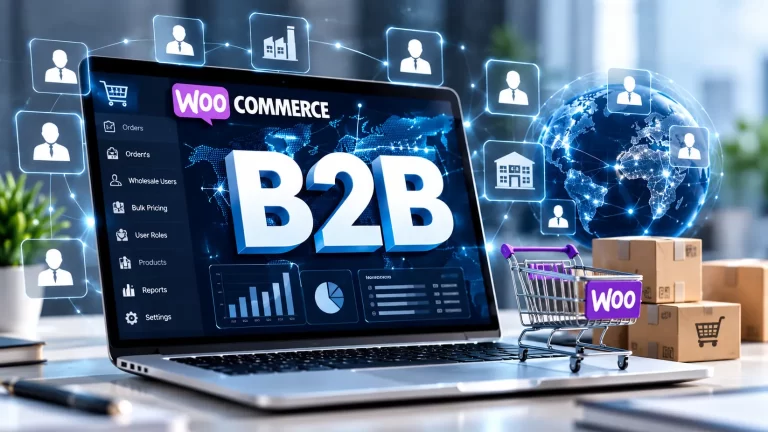
B2B WooCommerce store development helps manufacturers, wholesalers, distributors and business suppliers create online stores designed specifically for business-to-business purchasing. A B2B store works differently from a typical B2C eCommerce website. A consumer may purchase one product at a standard retail price.
Table of Contents
A business customer may order 50, 100 or 1,000 units and expect a different price, payment terms, shipping arrangement or ordering process.
That means a standard WooCommerce store may not provide everything a B2B company needs.
A professional B2B WooCommerce store can be customized to support wholesale pricing, customer-specific catalogs, bulk ordering, minimum order quantities, business accounts, quotation requests, purchase workflows and integrations.
What Is B2B WooCommerce Store Development?
B2B WooCommerce store development involves building a WooCommerce website specifically for business customers rather than focusing only on individual retail shoppers.
A B2B WooCommerce store can allow businesses to:
- Create company accounts
- Browse wholesale products
- View business-specific pricing
- Place bulk orders
- Request quotations
- Set minimum order quantities
- Reorder products
- Manage multiple users
- View order history
- Request invoices
- Use approved payment methods
The exact functionality depends on the company’s sales process.
For example, a manufacturer may want approved distributors to log in and see negotiated prices.
A wholesaler may want retailers to order products in predefined carton quantities.
A supplier may want customers to submit quotation requests instead of paying immediately online.
The website should therefore be built around the company’s actual B2B workflow.
Why B2B Businesses Need a Different WooCommerce Store
A normal online store usually follows a simple process:
Product → Add to Cart → Checkout → Payment
A B2B purchasing process can be more complicated:
Business Registration → Approval → Customer-Specific Catalog → Bulk Pricing → Cart → Purchase Order → Invoice → Delivery
Some B2B customers may also require:
- Credit terms
- Purchase orders
- Minimum quantities
- Tiered pricing
- Tax information
- Multiple delivery addresses
- Multiple employees under one company account
This is why B2B functionality should be considered during the planning stage.
9 Powerful Features of B2B WooCommerce Store Development
1. Business Customer Registration
A B2B store can provide a dedicated registration process for business customers.
Instead of asking only for:
- Name
- Password
the registration form can collect:
- Company name
- Contact person
- Business email
- Phone number
- Billing address
- Shipping address
- Tax information
- Business type
- Company registration information
The business account can then be reviewed before the customer receives access to wholesale pricing.
This can help businesses maintain greater control over their B2B customer base.
2. Customer-Specific Pricing
One of the most important requirements in B2B WooCommerce store development is flexible pricing.
Different business customers may receive different prices.
For example:
| Customer Type | Product Quantity | Price |
|---|---|---|
| Standard Business | 1–9 | ₹1,000 |
| Wholesale Buyer | 10–49 | ₹900 |
| Distributor | 50–99 | ₹800 |
| Large Distributor | 100+ | ₹700 |
These prices can be configured according to the company’s commercial agreements.
A business can therefore maintain different pricing levels without creating separate products for every customer group.
3. Bulk Ordering
B2B customers often need to order multiple products or large quantities quickly.
A standard product page may not be enough.
A B2B store can provide:
- Quantity fields
- Bulk order tables
- Quick order forms
- SKU search
- Product search
- Multiple-product ordering
- CSV-based ordering where required
For example, a retailer could enter:
SKU 1001 → 50 units
SKU 1002 → 100 units
SKU 1003 → 25 units
and add the products to the cart without opening every product page individually.
This can significantly simplify repetitive wholesale ordering.
4. Minimum Order Quantities
Many wholesale businesses cannot process very small orders.
For example:
Minimum order quantity: 20 units
or:
Minimum carton quantity: 10 pieces
The WooCommerce store can enforce these rules.
If a customer enters an amount below the required quantity, the website can display a message such as:
Minimum order quantity is 20 units.
This prevents customers from submitting orders that do not meet the supplier’s commercial requirements.
5. Tiered Wholesale Pricing
Another important feature is quantity-based pricing.
For example:
1–9 units: ₹500 each
10–49 units: ₹450 each
50–99 units: ₹400 each
100+ units: ₹350 each
The price can update based on the customer’s selected quantity.
This gives buyers a clear understanding of how larger orders affect their unit price.
For wholesalers and manufacturers, tiered pricing can be particularly useful because the commercial model is often based on order volume.
6. Request a Quote
Not every B2B transaction should end with an immediate online payment.
Some customers may need a quotation before placing an order.
A B2B WooCommerce store can include a:
Request a Quote
button.
The customer can submit:
- Products
- Quantities
- Company details
- Delivery location
- Message
- Required date
The sales team can then review the request and provide a quotation.
This is useful for products with:
- Custom pricing
- Large order volumes
- Variable shipping
- Custom configurations
- Negotiated contracts
7. Business Account Management
A larger B2B customer may have several employees purchasing on behalf of one company.
For example:
ABC Retail Pvt. Ltd.
could have:
- Purchasing Manager
- Sales Manager
- Accounts Manager
- Administrator
A custom B2B WooCommerce system can support different users under a company account.
Depending on requirements, different users can have different permissions.
For example:
Buyer: Can create orders.
Manager: Can review orders.
Administrator: Can manage company users.
This type of structure can be particularly useful for larger wholesale customers.
8. Reordering and Order History
B2B customers frequently purchase the same products repeatedly.
A good B2B store can make reordering easier.
Customers can view:
- Previous orders
- Product quantities
- Order dates
- Invoices
- Delivery details
- Order status
A Reorder button can allow customers to add previously purchased products back to the cart.
This can save time for businesses that purchase the same inventory every week or month.
9. Flexible Checkout and Payment Options
B2B checkout requirements can be different from retail checkout.
Depending on the business model, customers may require:
- Credit terms
- Bank transfer
- Purchase order
- Online payment
- Cash on delivery where applicable
- Approved business accounts
The checkout can also collect relevant company information.
For example:
Company Name
Billing Address
Shipping Address
Tax Information
Purchase Order Number
The final payment and tax configuration should be implemented according to the business’s applicable accounting and compliance requirements.
B2B WooCommerce Store Structure
A B2B store can use a structure such as:
| Section | Purpose |
|---|---|
| Home | Introduce the business |
| Products | Display wholesale catalog |
| Categories | Organize products |
| Business Registration | Register wholesale customers |
| Wholesale Pricing | Explain pricing model |
| Request a Quote | Collect quotation requests |
| Bulk Order | Enable fast ordering |
| My Account | Manage business account |
| Orders | View previous orders |
| Reorder | Repeat previous purchases |
| Contact | Sales and support |
The structure should be adapted to the company’s sales process.
B2B WooCommerce Product Pages
B2B product pages often need more information than B2C product pages.
A product page can include:
- Product name
- SKU
- Product description
- Specifications
- Available quantities
- Wholesale price
- Quantity breaks
- Minimum order quantity
- Packaging information
- Shipping information
- Related products
- Request quote button
For industrial or technical products, downloadable documents can also be provided.
For example:
- Product specifications
- Datasheets
- Installation guides
- Catalogues
- Certificates
This allows business customers to make purchasing decisions using detailed product information.
B2B Wholesale Catalog Management
Some businesses do not want every visitor to see wholesale pricing.
The website can be configured so that:
Guest Visitor
→ Sees general product information
Approved Business Customer
→ Sees wholesale prices
This approach can be useful when pricing is negotiated between suppliers and individual customers.
Some businesses may also want products to remain hidden until the customer logs in.
The catalog structure should therefore be based on the organization’s sales strategy.
B2B Customer Groups
A WooCommerce B2B website can create different customer groups.
For example:
- Retailer
- Distributor
- Wholesaler
- Reseller
- Corporate Buyer
- VIP Customer
Each group can have different:
- Prices
- Discounts
- Product visibility
- Minimum quantities
- Payment methods
- Shipping rules
This provides greater flexibility than a single pricing structure.
Wholesale WooCommerce Pricing
Pricing is one of the most important components of B2B WooCommerce store development.
Businesses can use:
Quantity-Based Pricing
The unit price changes according to quantity.
Role-Based Pricing
Different customer roles receive different prices.
Customer-Specific Pricing
Individual companies can receive negotiated prices.
Category-Based Discounts
Customers can receive discounts on selected categories.
Promotional Pricing
Temporary offers can be applied to specific products or customer groups.
The correct pricing method depends on the company’s sales agreements.
B2B WooCommerce Search and Filtering
Large wholesale catalogs need efficient search.
Business buyers may already know the:
- Product name
- SKU
- Model number
- Brand
- Category
Search can therefore be designed around both product names and technical identifiers.
Filters can include:
- Brand
- Category
- Product type
- Size
- Material
- Price
- Availability
- SKU
A fast search experience can reduce the time required to create an order.
Quick Order Functionality
A quick-order page can be especially useful for repeat B2B customers.
For example:
| SKU | Product | Quantity |
|---|---|---|
| SKU-101 | Product A | 50 |
| SKU-205 | Product B | 25 |
| SKU-310 | Product C | 100 |
The buyer can enter quantities and add everything to the cart in one action.
For businesses managing hundreds or thousands of SKUs, this can be more efficient than traditional shopping navigation.
B2B WooCommerce and Inventory
Inventory management becomes important when customers place large orders.
The website can display:
- Stock availability
- Available quantities
- Backorder status
- Estimated availability
- Product lead time
A B2B store can also integrate with external inventory or ERP systems.
For example:
ERP → Inventory → WooCommerce
The exact integration depends on the ERP system and available API.
B2B WooCommerce ERP Integration
Larger companies may already use an ERP or inventory system.
A custom WooCommerce integration can synchronize information such as:
- Products
- Inventory
- Prices
- Customers
- Orders
- Shipping
- Invoices
This can reduce the need for employees to enter the same information into multiple systems.
However, integration requirements should be analyzed carefully before development.
B2B WooCommerce Shipping
Wholesale orders can have different shipping requirements than retail orders.
A B2B store may need:
- Shipping by quantity
- Shipping by weight
- Location-based rates
- Freight calculations
- Customer-specific shipping
- Multiple delivery addresses
- Local pickup
- Custom shipping rules
For very large orders, shipping may also require manual quotation.
The website can therefore provide a flexible shipping workflow.
B2B WooCommerce Tax and Billing
Business customers may need proper billing information on their orders.
Depending on the business and applicable requirements, the website may collect:
- Company name
- Billing address
- Shipping address
- Tax identification information
- Purchase order number
Invoices can also be generated through the appropriate WooCommerce or accounting workflow.
The exact tax configuration should be reviewed with the business’s accountant or tax professional.
B2B WooCommerce Customer Dashboard
A customer dashboard can provide a central place for business buyers to manage their account.
It may include:
My Orders
View previous purchases.
My Quotes
Review quotation requests.
My Addresses
Manage billing and shipping addresses.
Company Information
View business details.
Reorder
Repeat previous purchases.
Invoices
Access available invoices.
A customized dashboard can make the purchasing process easier for repeat customers.
B2B WooCommerce Website Security
Security is particularly important when a store manages business accounts, customer information and payments.
Important measures include:
- HTTPS
- Secure administrator accounts
- Strong passwords
- Role-based permissions
- Regular backups
- WooCommerce updates
- Plugin updates
- Spam protection
- Secure payment processing
- Malware monitoring
Private wholesale pricing and customer information should not be exposed publicly.
Mobile-Friendly B2B WooCommerce Store
B2B buyers may also place orders from smartphones or tablets.
A responsive store should provide:
- Mobile-friendly navigation
- Search
- Product filtering
- Quantity controls
- Easy cart access
- Simple checkout
- Responsive tables
- Readable pricing
- Easy account access
However, B2B interfaces can sometimes contain more information than standard retail stores.
The design should therefore prioritize clarity rather than trying to fit every desktop feature onto one small screen.
B2B WooCommerce SEO
SEO remains important even for B2B stores.
A business can optimize pages around relevant searches such as:
- B2B WooCommerce store development
- Wholesale WooCommerce store
- B2B ecommerce website
- Wholesale products
- Bulk ordering
- Industrial products
- Business supplier
- Wholesale distributor
Product and category pages should have:
- Unique titles
- Useful descriptions
- Search-friendly URLs
- Optimized images
- Internal links
- Relevant metadata
Google Search Central provides official guidance for website owners working on search visibility. Google Search Central
B2B E-Commerce Content Strategy
A B2B website can publish useful content for business buyers.
Examples include:
- Product buying guides
- Wholesale buying guides
- Industry articles
- Product comparisons
- Technical guides
- Installation instructions
- Case studies
- FAQs
For example:
How to Choose the Right Commercial Packaging Supplier
or:
Bulk Buying Guide for Industrial Components
This content can attract relevant visitors while helping existing customers make purchasing decisions.
B2B WooCommerce Website Performance
B2B stores can contain hundreds or thousands of products.
Performance should therefore be considered from the beginning.
Important optimizations include:
- Image compression
- WebP images
- Efficient database queries
- Caching
- Optimized CSS
- Optimized JavaScript
- CDN where appropriate
- Good hosting
- Efficient search
- Limited unnecessary plugins
Large product catalogs may require additional optimization as the store grows.
Custom B2B WooCommerce Development
Standard WooCommerce provides a strong foundation, but every B2B business has different requirements.
Custom development can be used for:
- Customer-specific pricing
- Custom quotation systems
- Bulk ordering
- Company accounts
- Approval workflows
- ERP integrations
- Custom dashboards
- Purchase orders
- Advanced shipping
- Custom reports
The objective should be to customize only where the business actually needs additional functionality.
WooCommerce B2B vs Standard WooCommerce
| Feature | Standard B2C Store | B2B WooCommerce Store |
|---|---|---|
| Retail Pricing | Usually | Optional |
| Wholesale Pricing | Limited | Yes |
| Customer Groups | Basic | Advanced |
| Bulk Ordering | Basic | Advanced |
| Minimum Quantity | Optional | Common |
| Quote Requests | Optional | Common |
| Company Accounts | Limited | Yes |
| Purchase Orders | Limited | Possible |
| Customer-Specific Pricing | Limited | Yes |
| Reordering | Basic | Important |
| Multiple Buyers | Limited | Possible |
| ERP Integration | Optional | Often important |
The right configuration depends on the business model.
How Much Does B2B WooCommerce Store Development Cost?
The cost of B2B WooCommerce store development depends on the functionality required.
Basic B2B Store
A basic store may include:
- Product catalog
- Business registration
- Wholesale pricing
- Bulk quantities
- Contact forms
- Standard checkout
Advanced B2B Store
An advanced platform may include:
- Customer-specific pricing
- Tiered pricing
- Quote requests
- Company accounts
- Purchase orders
- Reordering
- Advanced shipping
- Custom dashboards
Enterprise B2B Store
A larger implementation may require:
- ERP integration
- Inventory synchronization
- Custom APIs
- Multiple customer groups
- Advanced reporting
- Custom approval workflows
- Large product catalogs
Therefore, the development budget should be based on the actual workflow rather than simply the number of products.
How to Choose a B2B WooCommerce Development Company
When choosing a company for B2B WooCommerce store development, consider these factors.
WooCommerce Experience
Review previous WooCommerce projects and confirm that the developer understands more than basic retail stores.
B2B Experience
Ask whether the company has worked with wholesale, distributor or business purchasing workflows.
Custom Development
Check whether the team can develop custom functionality when standard plugins are not enough.
Integration Experience
If you use an ERP, CRM or inventory platform, ask about API integration experience.
Performance
Large catalogs require careful performance planning.
Security
Ask how customer accounts, payments and administrator access will be protected.
Post-Launch Support
B2B stores often evolve as sales processes change, so ongoing maintenance can be useful.
Common B2B WooCommerce Mistakes
1. Treating B2B Customers Like Retail Customers
Business buyers often have different requirements.
2. No Customer-Specific Pricing
Negotiated pricing should be supported when necessary.
3. Complicated Bulk Ordering
Wholesale buyers should be able to order multiple products efficiently.
4. No Minimum Quantity Rules
If the business sells only in bulk, the website should enforce the appropriate minimums.
5. No Quote Functionality
Some B2B transactions require negotiation before purchase.
6. Poor Product Search
Large catalogs need efficient search and filtering.
7. No Reordering
Repeat buyers should be able to reorder frequently purchased products easily.
8. Ignoring Mobile Users
Business customers can also purchase from mobile devices.
Internal Linking for B2B WooCommerce
A B2B WooCommerce page can connect naturally to related services.
For example:
B2B WooCommerce → WooCommerce Development → Custom WordPress Development → Website Maintenance
For businesses looking for a development partner, link naturally to:
A relevant WooCommerce service page can also be linked from the article:
WooCommerce Development Company in Delhi
Why Professional B2B WooCommerce Development Matters
A B2B store needs to support the way businesses actually purchase.
A successful platform can combine:
- Wholesale pricing
- Customer groups
- Bulk ordering
- Minimum quantities
- Quote requests
- Business accounts
- Reordering
- Payment options
- Shipping rules
- Inventory
- Integrations
- Security
Instead of forcing an existing B2B sales process into a standard retail store, the website should be designed around the company’s actual workflow.
Why Choose NJ Technos?
NJ Technos can develop customized WooCommerce websites for businesses that require functionality beyond a standard online store.
A B2B project can be planned around:
- Wholesale catalogs
- Customer-specific pricing
- Bulk ordering
- Quote requests
- Business accounts
- Custom checkout
- ERP integrations
- Custom dashboards
- Performance optimization
The goal is to create a WooCommerce platform that supports both the company’s sales team and its business customers.
Frequently Asked Questions
What is B2B WooCommerce store development?
B2B WooCommerce store development involves customizing WooCommerce for business-to-business purchasing, including wholesale pricing, bulk ordering, customer accounts, quotations and business-specific checkout workflows.
Can WooCommerce handle wholesale pricing?
Yes. WooCommerce can be customized to support wholesale, tiered and customer-specific pricing.
Can B2B customers get different prices?
Yes. Pricing can be configured based on customer roles, companies, quantities or negotiated agreements.
Can WooCommerce support minimum order quantities?
Yes. Minimum quantity rules can be implemented according to product or customer requirements.
Can a B2B WooCommerce store support quote requests?
Yes. A Request a Quote workflow can allow customers to submit products and quantities for sales-team review.
Can businesses reorder previous products?
Yes. A customized account area can provide order history and reorder functionality.
Can multiple employees use one company account?
Yes. Custom B2B functionality can support multiple users with different permissions under a business account.
Can B2B WooCommerce integrate with an ERP?
Yes. WooCommerce can be connected with compatible ERP, CRM, inventory or accounting systems through APIs or integration solutions.
Is WooCommerce suitable for wholesale businesses?
WooCommerce can be used for wholesale and B2B stores when the required business functionality is properly configured or custom-developed.
How much does B2B WooCommerce development cost?
The cost depends on features such as pricing rules, customer accounts, bulk ordering, quotation workflows, integrations, dashboards and catalog size.
Final Thoughts
B2B WooCommerce store development can transform a traditional wholesale sales process into a more organized digital purchasing experience.
A successful B2B store should do more than display products.
It should support the way business customers actually buy.
Features such as customer-specific pricing, bulk ordering, minimum quantities, quotation requests, company accounts, tiered pricing, reordering and flexible payment workflows can make the platform more useful for wholesalers, manufacturers, distributors and suppliers.
The most important step is to understand the existing B2B sales process before development begins.
Once that workflow is clearly mapped, WooCommerce can be customized to create a scalable platform that supports both the business and its customers.