
The right website design for EV charging company should do much more than present company information. It should help visitors understand charging solutions, explore products and services, find charging locations, request quotations and connect with the business. NJ Technos helps businesses build professional, scalable websites designed around their specific digital requirements.
Table of Contents
Whether you operate EV charging stations, manufacture EV chargers, install charging infrastructure or provide charging software, your website can become an important part of your digital growth strategy.
A modern EV charging website should make technical information easy to understand while giving customers clear reasons to contact your business.
Why Website Design for EV Charging Company Is Important
EV charging is a specialized industry. Your potential customers may include individual EV owners, fleet operators, commercial property owners, hotels, offices, shopping centers, real estate developers and government or infrastructure organizations.
Each audience can have different requirements.
An EV driver may want to find the nearest charging station.
A property owner may want to understand installation requirements.
A fleet operator may want information about charging capacity and infrastructure.
A business may want to request a quotation for multiple charging points.
A good website should provide an easy path for each type of visitor.
Professional website design for EV charging company can help businesses:
- Explain EV charging solutions
- Showcase charging products
- Generate B2B leads
- Promote charging stations
- Display technical specifications
- Build customer trust
- Improve search visibility
- Generate quotation requests
- Support sales teams
- Provide useful information to EV customers
The website should therefore be designed around both customer experience and business objectives.
9 Powerful Features Every EV Charging Website Should Have
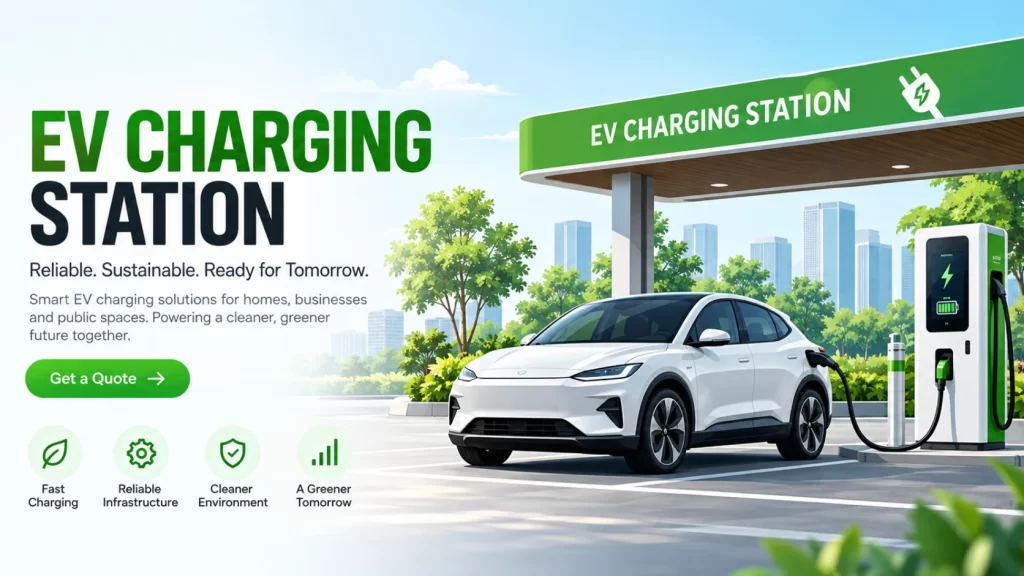
1. Clear EV Charging Solutions
The first thing visitors should understand is what your company actually provides.
Instead of presenting a large amount of technical information on the homepage, organize your solutions into clear categories.
Depending on your business, these could include:
- AC EV chargers
- DC fast chargers
- Public charging stations
- Commercial EV charging
- Workplace charging
- Fleet charging
- Residential EV charging
- Apartment charging solutions
- Highway charging
- EV charging software
- Charging management systems
Each major solution can have its own dedicated page.
For example, a company offering commercial charging could have separate pages for:
Commercial EV Charging
Fleet Charging Solutions
Workplace EV Charging
Public Charging Infrastructure
This structure makes the website easier to navigate and also provides opportunities to target relevant search terms.
2. Add an EV Charging Station Locator
For charging network operators, a station locator can be one of the most useful features on the website.
Users may want to search charging stations according to:
- Location
- City
- Distance
- Charger type
- Charging speed
- Connector type
- Availability
An interactive map can make it easier for EV drivers to locate charging points.
The interface should be especially mobile-friendly because users may be searching for a charging station while travelling.
Depending on the business model, the station locator can potentially connect with an external charging platform or API to retrieve location information.
A well-designed locator can therefore turn the website from a simple information platform into a useful customer tool.
3. Create Detailed EV Charger Product Pages
If your company manufactures or sells EV chargers, individual products should have dedicated pages.
A product page can include:
- Product name
- Product images
- Charging capacity
- AC/DC classification
- Connector type
- Input specifications
- Output specifications
- Dimensions
- Installation requirements
- Operating conditions
- Safety features
- Connectivity options
- Warranty information
- Datasheets
- Brochures
- Request-a-Quote button
Technical specifications should be organized clearly.
Instead of putting everything into a single paragraph, use specification tables, tabs or clearly separated sections.
This allows technical buyers to quickly find the information they need while keeping the page understandable for less technical visitors.
4. Create Strong Lead Generation Opportunities
Many EV charging businesses depend on enquiries rather than direct online purchases.
Your website should therefore make contacting the business easy.
Useful calls to action include:
- Request a Quote
- Get Pricing
- Talk to an Expert
- Book a Consultation
- Request Installation
- Download Brochure
- Become a Partner
- Contact Sales
Forms should collect enough information to qualify an enquiry without becoming unnecessarily complicated.
For example, an installation enquiry could include:
- Name
- Company
- Phone
- City
- Property type
- Number of charging points
- Charger requirement
- Project details
The sales team can then understand the enquiry before contacting the potential customer.
5. Build Location-Based Pages
Location can be particularly important for EV charging businesses.
If your company operates across different cities or states, useful location pages can help visitors understand where your services are available.
For example:
- EV Charging Solutions in Delhi
- EV Charger Installation in Gurgaon
- EV Charging Solutions in Noida
- EV Charging Stations in Mumbai
- Commercial EV Charging in Bengaluru
However, each location page should contain genuinely useful information.
Simply changing the city name on identical pages does not create a strong local SEO strategy.
A useful location page could explain:
- Services available in the location
- Charging solutions
- Installation services
- Coverage area
- Local projects
- Contact information
- FAQs
This provides value to visitors while creating relevant local search opportunities.
6. Make the Website Mobile-First
An EV charging website needs to work extremely well on smartphones.
Users may access the website while:
- Driving or travelling
- Looking for charging stations
- Checking product information
- Calling an installation company
- Requesting a quote
- Finding directions
The mobile website should therefore provide:
- Simple navigation
- Large buttons
- Easy-to-read text
- Fast-loading images
- Click-to-call functionality
- Easy map interaction
- Short forms
- Clear CTAs
A visitor should not have to zoom in or struggle with navigation to find basic information.
Responsive design should be considered from the beginning of the development process.
7. Focus on Website Performance
EV charging websites can become technically heavy because they may contain:
- Large product images
- Maps
- Videos
- Interactive elements
- Third-party APIs
- Tracking scripts
- Product catalogs
Poorly optimized assets can increase page-loading times.
Important performance practices include:
- Image compression
- WebP or modern image formats
- Responsive images
- Lazy loading
- CSS optimization
- JavaScript optimization
- Browser caching
- Efficient API requests
- Removing unnecessary scripts
Performance is particularly important for mobile users.
Google provides guidance around search and website experience through Google Search Central.
8. Create an SEO-Friendly Website Structure
Search engines need to understand what your company does and which services or products you provide.
An EV charging website can create dedicated pages for important topics such as:
- EV charging stations
- EV charger installation
- DC fast charging
- AC EV chargers
- Commercial EV charging
- Fleet charging
- Workplace charging
- EV charging infrastructure
- Public EV charging
- EV charger maintenance
The website should have a logical hierarchy.
For example:
EV Charging Solutions
→ Commercial EV Charging
→ Fleet Charging
→ Workplace Charging
→ Public Charging
And:
EV Chargers
→ AC EV Chargers
→ DC Fast Chargers
→ Fast Charging Stations
This structure makes it easier for users and search engines to understand the website.
9. Add Analytics and Conversion Tracking
Website traffic alone does not tell you whether your website is helping the business.
An EV charging company should track meaningful actions such as:
- Contact form submissions
- Quote requests
- Phone calls
- Brochure downloads
- Product enquiries
- Station searches
- Consultation bookings
- Partner applications
Analytics can help identify which pages and marketing channels are generating business opportunities.
For example, if a charger product page receives significant traffic but generates very few enquiries, you can investigate the page’s content, CTA, pricing information or user experience.
This data can then be used to improve the website.
EV Charging Website Design for Different Business Models
Every EV charging business has different requirements.
EV Charging Station Operators
Charging network operators may need:
- Station locator
- Interactive maps
- Charging locations
- Charger types
- Station details
- Availability information
- Mobile-friendly interfaces
- Customer support
The main objective is often helping EV drivers find and use charging stations.
EV Charger Manufacturers
Manufacturers typically require product-focused websites.
Important sections may include:
- Product catalog
- Product specifications
- Datasheets
- Applications
- Certifications
- Product comparisons
- Dealer information
- Distributor enquiries
- Technical resources
The website should make it easy for customers to compare different charging products.
EV Charger Installation Companies
Installation companies should focus heavily on service pages and lead generation.
Important pages can include:
- EV charger installation
- Home EV charging
- Commercial EV charging
- Workplace charging
- Fleet charging
- Site assessment
- Electrical installation
- Maintenance
Each service page should clearly explain what the company provides and how customers can request an enquiry.
Fleet Charging Companies
Fleet operators have different requirements from individual EV owners.
Their website should explain:
- Depot charging
- Fleet infrastructure
- Charging management
- Load management
- Charging schedules
- Reporting
- Scalability
- Maintenance
Dedicated fleet charging pages can help target B2B search queries.
Commercial EV Charging Providers
Commercial customers can include:
- Hotels
- Offices
- Shopping centers
- Hospitals
- Restaurants
- Apartment complexes
- Parking operators
- Real estate developers
Creating dedicated industry pages can help explain how EV charging can be implemented for each type of property.
EV Charging Website vs Generic Business Website
A specialized EV charging website often needs functionality that a standard business website does not.
| Feature | Generic Business Website | EV Charging Website |
|---|---|---|
| Company information | Yes | Yes |
| Services | Yes | Yes |
| Charger specifications | Limited | Yes |
| Station locator | Usually not required | Often important |
| Map integration | Optional | Often important |
| Charging information | Limited | Essential |
| Product catalog | Optional | Often important |
| Location pages | Optional | Important |
| Quote generation | Yes | Yes |
| Mobile experience | Important | Critical |
| EV-specific SEO | No | Yes |
| Technical resources | Limited | Important |
The exact functionality should depend on the company’s business model.
SEO Strategy for an EV Charging Website
SEO can help EV charging companies reach potential customers searching for charging products and services.
Product Keywords
Examples include:
- EV charger
- AC EV charger
- DC fast charger
- EV charging station
- commercial EV charger
Service Keywords
Examples include:
- EV charger installation
- EV charging station installation
- commercial EV charger installation
- fleet charging installation
Location Keywords
Examples include:
- EV charging station Delhi
- EV charger installation Gurgaon
- EV charging station Mumbai
- EV charging solutions Bengaluru
Informational Keywords
Content can target searches such as:
- How does DC fast charging work?
- What is an AC EV charger?
- How long does EV charging take?
- What EV charger should a business install?
- How many EV chargers does a fleet need?
A combination of commercial and informational content can help attract potential customers at different stages of the buying journey.
How a Good EV Charging Website Generates Leads
The website should guide visitors from discovery to action.
A typical journey could look like:
Google Search
↓
EV Charging Service Page
↓
Relevant Solution
↓
Product or Technical Information
↓
Trust Signals
↓
Request a Quote
↓
Sales Enquiry
The same journey can also start through:
- Google Ads
- Meta Ads
- Industry directories
- Referral traffic
- Email marketing
The website acts as the destination where the visitor evaluates the company.
Trust Signals for EV Charging Websites
EV charging infrastructure can involve significant technical and commercial decisions.
Potential customers may want to know whether they can trust the company before making an enquiry.
Useful trust signals include:
- Certifications
- Client logos
- Case studies
- Project photographs
- Testimonials
- Product warranties
- Technical documentation
- Industry experience
- Installation experience
- Service coverage
- Customer support information
Case studies can be especially effective for B2B businesses.
For example:
Project → Requirement → Solution → Installation → Outcome
This gives prospective customers a clearer understanding of the company’s capabilities.
Content Marketing for EV Charging Companies
A blog or resource center can support both SEO and customer education.
Potential topics include:
- EV charging basics
- AC vs DC charging
- EV charger installation
- Fleet charging
- Workplace charging
- Public charging infrastructure
- EV charger maintenance
- EV charging costs
- Charging technology
- EV infrastructure planning
Content should be written for the intended audience.
Technical information is useful, but it should be explained clearly enough for non-technical decision-makers.
B2B Website Design for EV Charging Companies
B2B customers often need more information before requesting a quotation.
A commercial EV charging website should clearly explain:
- Available solutions
- Charging capacity
- Installation process
- Project requirements
- Number of charging points
- Software capabilities
- Maintenance
- Support
- Pricing or quotation process
Industry-specific pages can also be useful.
EV Charging for Hotels
Explain how hotels can provide charging facilities to guests.
EV Charging for Offices
Explain workplace charging for employees and visitors.
EV Charging for Fleets
Explain depot charging and fleet infrastructure.
EV Charging for Retail
Explain how charging stations can complement customer parking facilities.
Maps and API Integration
Some EV charging websites require external integrations.
These may include:
- Mapping services
- Charging station databases
- Charging management software
- Payment systems
- CRM systems
- Analytics platforms
- Inventory systems
These integrations should be planned before development begins.
For example, a charging station locator may need to retrieve data dynamically instead of displaying a manually maintained list.
The technical architecture should therefore account for API requirements, data synchronization and website performance.
How Much Does an EV Charging Website Cost?
There is no fixed cost for developing an EV charging website.
The final cost depends on the project’s functionality and complexity.
Factors include:
- Number of pages
- UI/UX requirements
- Custom design
- CMS
- Product catalog
- Station locator
- Maps
- API integrations
- Customer accounts
- Charging software integration
- CRM integration
- Forms
- SEO
- Content
- Ongoing maintenance
A simple EV charging company website may have a relatively straightforward structure.
A charging network platform with live station data, user accounts and software integrations can require considerably more custom development.
It is therefore better to define the project requirements before comparing development costs.
How to Choose a Website Development Company for Your EV Business
Choosing the right development partner can affect the website’s long-term performance.
Consider these factors:
Relevant Experience
Review the company’s previous projects and technical experience.
Custom Development
If your project requires APIs, maps, product configurators or other specialized functionality, make sure the development team can handle custom requirements.
SEO Knowledge
The agency should understand technical SEO, content structure and search-friendly website architecture.
Mobile Development
Ask how the website will be tested across smartphones and tablets.
Performance
Discuss image optimization, JavaScript, CSS, caching and third-party integrations.
Security
Forms, APIs, user accounts and external integrations should be developed with security in mind.
Maintenance
Ask who will handle updates, bug fixes and future development after launch.
Scalability
Your website should be capable of supporting additional products, locations, services and integrations as the business grows.
Common EV Charging Website Mistakes
Using Too Much Technical Jargon
Technical specifications are important, but customers also need simple explanations.
Hiding Important Information
Visitors should not have to search through multiple pages to understand your products or services.
Weak Calls to Action
Every important page should give visitors a clear next step.
Poor Mobile Experience
A charging website should be easy to use on mobile devices.
Slow Maps and Heavy Pages
Interactive maps, videos and third-party scripts can affect performance if not implemented efficiently.
No Location Strategy
If you operate in multiple locations, your website should clearly communicate where your services are available.
Ignoring SEO
A visually impressive website may still receive little organic traffic if its content and technical structure are not optimized.
No Conversion Tracking
Without tracking, it becomes difficult to understand which pages and campaigns generate enquiries.
Why Choose NJ Technos for EV Charging Website Development?
A specialized EV charging website requires a combination of design, development, performance and digital marketing expertise.
NJ Technos can help businesses create websites using WordPress, WooCommerce and custom development solutions where required.
Services can include:
- Custom website design
- WordPress development
- WooCommerce development
- Custom WordPress themes
- Custom WordPress plugins
- Product catalog development
- Lead-generation forms
- API integrations
- Website redesign
- Performance optimization
- SEO-friendly website structure
- Website maintenance
For businesses requiring custom WordPress solutions, explore WordPress development services.
For businesses selling EV charging products online, WooCommerce development services can also be useful.
Frequently Asked Questions
What should an EV charging company website include?
An EV charging website can include charging solutions, product pages, technical specifications, installation services, charging locations, station maps, FAQs, case studies, contact forms and quote-generation options.
Should an EV charging website have a station locator?
If the company operates a charging network, a station locator can be an important feature. It can help EV drivers find charging locations based on their requirements.
Can an EV charging website integrate maps?
Yes. Mapping functionality can be integrated into an EV charging website. More advanced charging networks may also require external APIs for station and charging data.
Is SEO important for EV charging companies?
Yes. SEO can help EV charging businesses reach users searching for chargers, charging stations, installation services and charging infrastructure.
Can WordPress be used for an EV charging website?
Yes. WordPress can be used for corporate EV charging websites, product catalogs, service websites and lead-generation platforms. Complex charging-network functionality may require custom development and API integrations.
Can an EV charging website generate B2B leads?
Yes. Dedicated solution pages, industry pages, case studies, technical resources and quotation forms can help generate relevant B2B enquiries.
How much does EV charging website development cost?
The cost depends on design, number of pages, product functionality, maps, APIs, station locators, integrations, SEO and ongoing maintenance.
Can an existing EV charging website be redesigned?
Yes. A redesign can improve visual design, mobile usability, navigation, performance, SEO structure and conversion paths while retaining useful existing content.
Final Thoughts
A successful EV charging website needs to do more than explain what the company does.
It should help visitors understand charging solutions, explore products or locations, evaluate the company’s expertise and take the next step toward an enquiry.
The right website design for EV charging company combines clear information architecture, mobile-first design, product and service pages, SEO, performance optimization and conversion-focused functionality.
Whether you manufacture EV chargers, operate charging stations, install charging infrastructure or provide commercial and fleet charging solutions, your website can become an important part of your digital growth strategy.
A well-planned website can support customer education, organic search visibility, lead generation and long-term business growth.