The electric vehicle industry in India is creating new opportunities across vehicle manufacturing, charging infrastructure, battery technology, fleet mobility, electric two-wheelers, electric three-wheelers, software and supporting services. For businesses operating in this rapidly developing industry, having a professional website is essential for communicating products, technology, services and business capabilities. NJ Technos helps businesses build professional, scalable websites tailored to their digital requirements.
Table of Contents
EV company website development India is not simply about creating an attractive corporate website. An EV business website needs to present technical information clearly, showcase products, communicate trust, generate enquiries and provide a smooth experience across desktop and mobile devices.
Whether you are an EV manufacturer, charging company, battery business, mobility startup, fleet solution provider or EV technology company, your website should be designed around your specific business model.
Why Do EV Companies Need a Professional Website?
An EV company’s website is often the first place where customers, distributors, investors, fleet operators and business partners learn about the company.
A well-developed website can help communicate:
- EV products
- Charging solutions
- Battery technology
- Mobility solutions
- Company capabilities
- Technical specifications
- Dealer information
- Service locations
- Business partnerships
- Career opportunities
- Contact information
For B2B businesses, the website can also act as a lead-generation platform.
A potential customer may discover your company through Google, visit a product page, download a brochure and submit a quotation request.
This means the website needs to support the entire customer journey.
What Is EV Company Website Development?
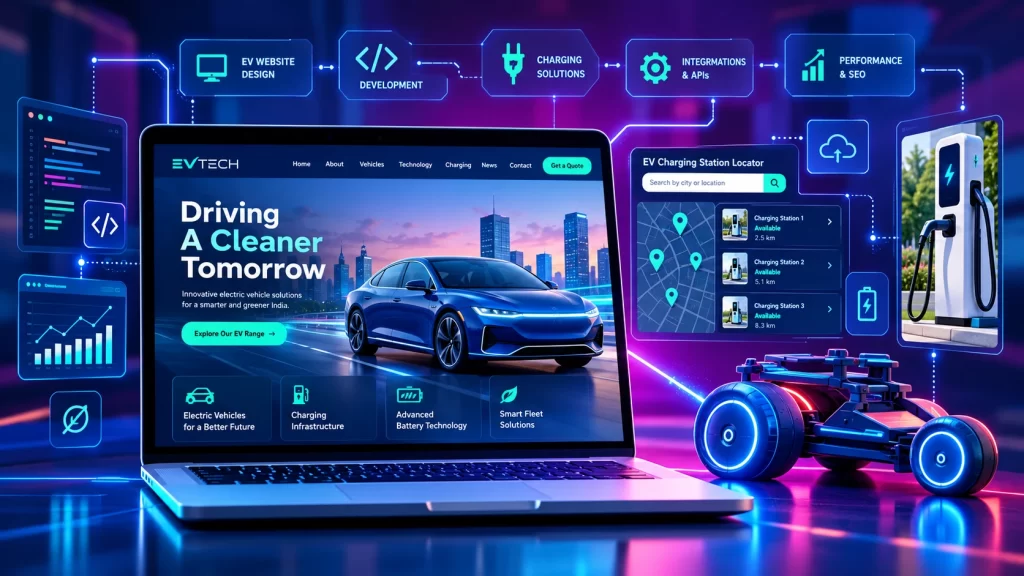
EV company website development involves designing and building a website specifically around the needs of an electric vehicle or electric mobility business.
Depending on the company, this may include:
- Corporate website development
- EV product catalog
- Vehicle specification pages
- Charging station pages
- Battery product pages
- Dealer locator
- Service center locator
- Charging station locator
- Lead-generation forms
- Product comparison
- Brochure downloads
- API integrations
- Ecommerce functionality
- Customer portals
- Blog and resource center
- SEO implementation
The exact functionality depends on the company’s products, customers and business model.
9 Powerful Features for EV Company Websites
1. Create a Strong EV-Focused Homepage
The homepage should immediately explain what the company does.
A visitor should be able to understand within a few seconds:
- What products or services you offer
- Who your customers are
- Where you operate
- What makes your company different
- What action they can take next
For example, an EV manufacturer might structure the homepage around:
Electric Vehicles
Technology
Models
Charging
Dealers
Support
A charging company might instead focus on:
Charging Solutions
Charging Stations
Locations
Business Solutions
Technology
Contact
The homepage should reflect the actual business model.
2. Build Detailed EV Product Pages
Product pages are particularly important for EV manufacturers and technology companies.
A product page can include:
- Product name
- Product images
- Product videos
- Key features
- Technical specifications
- Battery information
- Range information
- Charging information
- Dimensions
- Safety features
- Performance information
- Warranty
- Brochure
- Request a Quote
For an EV manufacturer, separate pages can be created for each vehicle model.
For a battery company, each battery solution can have its own dedicated page.
For a charging company, individual charger models can have detailed specifications.
This structure helps users find the information they need without overwhelming the main homepage.
3. Create an Easy-to-Understand Technical Experience
EV businesses often have highly technical products.
However, not every website visitor is an engineer.
Your website should therefore present technical information in layers.
Start with simple benefits:
Fast Charging
Long Range
Smart Connectivity
Advanced Safety
Then provide detailed specifications for users who need technical information.
Tables can be useful for displaying:
| Specification | Details |
|---|---|
| Battery Capacity | Product-specific |
| Charging Type | AC / DC |
| Charging Time | Product-specific |
| Range | Product-specific |
| Connectivity | Product-specific |
| Warranty | Product-specific |
This approach makes technical information easier to understand.
4. Add Dealer and Service Locators
EV businesses operating across India can benefit from location-based functionality.
Depending on the business, a website may include:
- Dealer locator
- Service center locator
- Charging station locator
- Installation partner locator
- Distributor locator
Users could search by:
- State
- City
- PIN code
- Distance
For example, an EV vehicle manufacturer could allow customers to find their nearest dealership.
A charging network could allow drivers to locate charging stations.
A battery company could provide information about authorized service partners.
These features can make the website considerably more useful than a basic corporate website.
5. Make the Website Mobile-First
Mobile usability is particularly important for EV businesses.
Potential customers may browse the website while:
- Searching for a vehicle
- Looking for a charging station
- Finding a dealer
- Checking specifications
- Contacting a service center
- Requesting a quotation
The website should therefore provide:
- Responsive layouts
- Fast-loading pages
- Easy navigation
- Large touch-friendly buttons
- Click-to-call functionality
- Simple enquiry forms
- Easy location searches
A mobile visitor should be able to reach important information without unnecessary scrolling or complicated menus.
6. Build Strong Lead Generation
Many EV businesses operate in B2B or high-consideration markets.
Customers may not purchase immediately.
They may first:
- Research the company
- Compare products
- Read specifications
- Download brochures
- Contact sales
- Request a quotation
- Schedule a meeting
Your website should support these actions.
Useful CTAs include:
- Request a Quote
- Talk to Sales
- Book a Consultation
- Download Brochure
- Become a Dealer
- Find a Dealer
- Request a Demo
- Contact Us
Forms should be short enough to encourage submissions but detailed enough to qualify leads.
7. Build an SEO-Friendly EV Website Structure
Search visibility is important for businesses competing in the EV industry.
Your website can target different types of searches.
Product Searches
- Electric scooter
- Electric car
- EV battery
- EV charger
- DC fast charger
Service Searches
- EV charger installation
- EV fleet solutions
- EV maintenance
- EV charging solutions
Industry Searches
- Electric mobility solutions
- EV fleet management
- EV charging infrastructure
- Electric vehicle technology
Location Searches
- EV company India
- EV manufacturer Delhi
- EV charging company Mumbai
- EV solutions Bangalore
Each important topic should have a dedicated page when there is sufficient useful information.
Avoid creating dozens of thin location pages that provide little value.
8. Add Analytics and Conversion Tracking
A professional website should provide measurable business data.
Track important actions such as:
- Contact form submissions
- Quote requests
- Brochure downloads
- Dealer enquiries
- Product enquiries
- Phone calls
- Demo requests
- Station searches
- Newsletter subscriptions
Analytics can show which pages are attracting visitors and which pages are generating enquiries.
For example, if a vehicle product page receives high traffic but generates few enquiries, the company can test:
- Product messaging
- Images
- CTA placement
- Specifications
- Trust signals
- Enquiry forms
Data can therefore be used to continuously improve the website.
9. Optimize Website Speed and Performance
EV websites can become heavy because they often contain:
- High-resolution vehicle images
- Product videos
- Interactive maps
- Animations
- Third-party APIs
- Product catalogs
- Tracking scripts
These elements should be optimized carefully.
Performance improvements can include:
- Image compression
- WebP images
- Responsive images
- Lazy loading
- CSS optimization
- JavaScript optimization
- Browser caching
- Efficient API requests
- Removal of unnecessary scripts
A fast website creates a better experience for visitors and provides a stronger technical foundation for SEO.
For technical search guidance, refer to Google Search Central.
EV Company Website Development for Different Businesses
Different EV businesses require different website structures.
EV Vehicle Manufacturers
An EV manufacturer may need:
- Vehicle models
- Product specifications
- Features
- Range information
- Charging information
- Test-drive forms
- Dealer locator
- Service locator
- Brochures
- Finance information
- Customer support
The website should make it easy for customers to compare models and request more information.
EV Charging Companies
Charging businesses may require:
- Charging solutions
- Charger products
- Charging station locator
- Charging network information
- AC charging
- DC fast charging
- Commercial charging
- Fleet charging
- Installation services
For a dedicated charging-focused website, you can also target the related website design for EV charging company topic.
EV Battery Companies
Battery manufacturers and technology providers may need:
- Battery products
- Technical specifications
- Applications
- Safety information
- Certifications
- Battery management systems
- Warranty
- Technical documentation
- B2B enquiry forms
EV Startups
EV startups often need to establish credibility quickly.
Their website may include:
- Company story
- Technology
- Products
- Leadership
- Investors
- Partnerships
- News
- Careers
- Contact information
The website should communicate the company’s value proposition clearly.
EV Fleet Solution Providers
Fleet businesses may require dedicated pages for:
- Fleet electrification
- Charging infrastructure
- Fleet management
- Charging management
- Energy management
- Reporting
- Maintenance
B2B customers typically need more detailed information before making a purchasing decision.
EV Website Design for B2B Customers
EV businesses often sell to other businesses.
Potential customers may include:
- Logistics companies
- Fleet operators
- Hotels
- Offices
- Shopping centers
- Real estate companies
- Government organizations
- Automobile dealers
- Transportation companies
These customers may want detailed information about:
- Project implementation
- Pricing
- Installation
- Infrastructure
- Maintenance
- Scalability
- Technology
- Support
A strong website should therefore provide enough information to help business decision-makers evaluate the solution.
Product Comparison Features
If an EV company offers multiple products, comparison functionality can improve the customer experience.
For example, users could compare:
- Battery capacity
- Range
- Charging time
- Motor power
- Dimensions
- Warranty
- Features
- Price
A comparison interface can make it easier for customers to identify the most relevant product.
This can be particularly useful for EV manufacturers and charger manufacturers with multiple product models.
Dealer and Partner Enquiries
EV companies that use dealer or distributor networks should provide a dedicated section for partners.
Useful CTAs include:
Become a Dealer
Become a Distributor
Partner With Us
Apply for Dealership
The form can collect:
- Name
- Company
- Location
- Business type
- Investment capacity
- Existing business
- Contact details
This can help sales teams qualify potential partners.
EV Website Content Strategy
A resource section can support SEO while educating potential customers.
Useful content topics include:
- How EV charging works
- AC vs DC charging
- EV battery technology
- EV maintenance
- Electric vehicle range
- EV charging costs
- Fleet electrification
- Benefits of electric mobility
- EV charging infrastructure
- How to choose an EV charger
Content should address real questions rather than simply repeating keywords.
A strong content strategy can attract visitors earlier in the buying journey.
Building Trust on an EV Company Website
Electric mobility products often involve significant purchasing decisions.
Trust signals can therefore play an important role.
Consider including:
- Certifications
- Awards
- Client logos
- Project case studies
- Product testing
- Technical documentation
- Customer reviews
- Warranty information
- Media coverage
- Industry partnerships
Case studies can demonstrate real-world experience.
A case study can explain:
Customer Requirement → Challenge → Solution → Implementation → Result
This can help prospective customers understand how your company handles real projects.
EV Company Website Development India: Why Local Market Understanding Matters
India’s EV market has unique customer, geographic and business requirements.
An EV company serving India may need to communicate information for customers across different:
- States
- Cities
- Languages
- Business segments
- Infrastructure environments
A website may therefore require location-specific information, dealer networks, service centers and region-based lead generation.
For national brands, the website should also have a scalable architecture capable of supporting new cities, products and services as the company expands.
Integrations for EV Company Websites
Advanced EV websites may need integration with external platforms.
Possible integrations include:
- CRM
- ERP
- Dealer management systems
- Charging APIs
- Maps
- Payment gateways
- Inventory systems
- Analytics
- Marketing platforms
- Customer support systems
These integrations should be planned before development.
For example, a dealer locator may need to retrieve dealer information from an external database.
A charging network may require live station information.
An ecommerce store may need inventory and shipping integrations.
Custom development can be used when standard plugins or integrations are not sufficient.
WordPress for EV Company Website Development
WordPress can be a suitable platform for many EV company websites, particularly corporate websites, product catalogs and lead-generation platforms.
It can support:
- Custom page structures
- Product catalogs
- Blog systems
- Location pages
- Custom forms
- API integrations
- Custom post types
- SEO plugins
- Analytics
- Custom themes
- Custom plugins
For businesses requiring specialized functionality, a WordPress development company in Delhi can build custom functionality around the WordPress platform.
WooCommerce for EV Products
If an EV company wants to sell products online, WooCommerce can provide ecommerce functionality.
It can be used for:
- EV accessories
- Chargers
- Charging cables
- Parts
- Components
- Merchandise
- Related products
An ecommerce website can include:
- Product filters
- Product variations
- Cart
- Checkout
- Payment gateways
- Shipping
- Customer accounts
- Order management
For businesses requiring custom ecommerce functionality, WooCommerce development services can be integrated into the overall website strategy.
How Much Does EV Company Website Development Cost in India?
There is no fixed price for EV website development.
The cost depends on the project’s scope and functionality.
Factors include:
- Number of pages
- Custom UI/UX
- Product catalog
- Dealer locator
- Service locator
- Charging station locator
- Maps
- API integrations
- CRM integration
- Ecommerce
- Custom forms
- Customer portals
- SEO
- Content
- Website maintenance
A simple corporate EV website will have very different requirements from a platform containing live charging data, customer accounts and multiple external integrations.
A proper requirement document should therefore be prepared before comparing development proposals.
How to Choose an EV Website Development Company
Before hiring a development company, evaluate:
Portfolio
Review previous websites and check whether the agency has handled technically complex projects.
Industry Understanding
The development team should understand how EV businesses communicate products and services.
Custom Development
Check whether the agency can handle custom functionality and APIs.
SEO
Make sure SEO-friendly architecture is considered during development.
Performance
Ask how the website will be optimized for mobile and desktop.
Security
Forms, APIs, customer accounts and third-party integrations should be implemented securely.
Support
Understand what happens after launch.
Scalability
Your website should be capable of supporting additional products, locations and services as your company grows.
Common EV Website Development Mistakes
Creating a Generic Corporate Website
An EV business needs to communicate its products, technology and solutions clearly.
Using Too Much Technical Language
Technical specifications are important, but they should be explained in a customer-friendly manner.
Poor Product Pages
Important specifications should be easy to find.
No Clear CTA
Every important page should provide a clear next step.
Ignoring Mobile Users
Many users will access the website through smartphones.
Slow Images and Videos
High-resolution vehicle imagery can significantly affect page performance if not optimized.
No SEO Structure
Important products and services should have dedicated, indexable pages.
No Analytics
Without tracking, it is difficult to understand how visitors interact with the website.
Why Choose NJ Technos for EV Website Development?
NJ Technos can help EV businesses create professional websites combining design, development, SEO and custom functionality.
Services can include:
- Custom website design
- WordPress development
- WooCommerce development
- Custom WordPress themes
- Custom WordPress plugins
- Product catalog development
- Lead-generation forms
- API integrations
- Website redesign
- Performance optimization
- SEO-friendly website development
- Website maintenance
For businesses that need custom functionality, custom WordPress plugin development can be used to extend a WordPress website beyond standard functionality.
For ongoing technical support, website maintenance services can help with updates, troubleshooting and improvements after launch.
Frequently Asked Questions
What is EV company website development?
EV company website development involves creating a website specifically for electric vehicle businesses, including manufacturers, charging companies, battery companies, mobility startups and EV technology providers.
What should an EV company website include?
An EV website can include product pages, technical specifications, dealer or service locators, charging information, company information, case studies, brochures, lead forms and contact options.
Can WordPress be used for EV websites?
Yes. WordPress can be used for corporate EV websites, product catalogs, lead-generation websites and many other EV business requirements. Advanced functionality may require custom development.
Can an EV website have a dealer locator?
Yes. A dealer locator can allow customers to search for dealerships based on city, state, PIN code or distance.
Can an EV website integrate maps?
Yes. Maps can be integrated for dealer locations, service centers, charging stations and other location-based features.
Is SEO important for EV companies?
Yes. SEO can help EV companies reach users searching for electric vehicles, EV chargers, charging solutions, batteries, fleet solutions and other relevant products and services.
Can an EV company sell products online?
Yes. Products such as chargers, accessories, cables and other EV-related products can be sold through an ecommerce website.
How much does an EV website cost in India?
The cost depends on design complexity, number of pages, product functionality, integrations, APIs, ecommerce requirements and ongoing support.
How long does EV website development take?
The timeline depends on the project’s scope. A basic corporate website can be completed faster than a complex website with product catalogs, dealer locators, APIs and customer portals.
Final Thoughts
The EV industry requires websites that can communicate complex technology in a simple and engaging way.
A successful website should showcase products, explain technology, generate enquiries, support dealers and partners, provide useful resources and create a smooth experience across devices.
Effective EV company website development India should therefore combine professional design, responsive development, SEO, performance optimization, analytics and business-focused functionality.
Whether you are an EV manufacturer, charging company, battery manufacturer, fleet solution provider or electric mobility startup, the right website can become an important part of your digital growth strategy.
A well-planned EV website provides a foundation that can grow alongside the business, allowing new products, locations, services and integrations to be added as the company expands.