The architecture industry depends heavily on visual presentation, credibility and strong project portfolios. For architecture practices, an impressive digital presence can help communicate design expertise, showcase completed projects and attract new clients. Professional architecture firm website design India should therefore combine elegant visual design with clear information, fast performance, mobile usability and strong lead-generation features.
Table of Contents
An architecture website is often the first place where potential clients, property developers, builders and business partners evaluate a firm’s work. A well-planned website can turn that first impression into a meaningful enquiry.
Whether you are an established architecture practice, an interior architecture studio, a residential architect, a commercial architecture firm or a growing design consultancy, your website should represent the quality of your work.
Why Architecture Firms Need a Professional Website
Architecture is a highly visual profession.
Clients want to see previous projects, understand the firm’s design philosophy and evaluate its experience before starting a conversation.
A professional website can showcase:
- Completed architecture projects
- Residential projects
- Commercial projects
- Hospitality projects
- Interior projects
- Institutional projects
- Landscape projects
- Architectural concepts
- Design process
- Company expertise
- Awards and recognition
- Client testimonials
- Contact information
Unlike a basic business website, an architecture website needs to communicate both visual quality and professional credibility.
A poorly designed website can make excellent architectural work appear less impressive, while a carefully designed website can create a premium experience around the firm’s portfolio.
Architecture Firm Website Design India: What Makes a Good Website?
A strong architecture website should balance aesthetics with functionality.
The website should look sophisticated without making navigation difficult.
Important elements include:
- High-quality project photography
- Strong typography
- Clean layouts
- Large visual sections
- Simple navigation
- Project filtering
- Detailed case studies
- Mobile responsiveness
- Fast loading
- Clear contact options
- SEO-friendly content
The website should also reflect the firm’s individual design identity.
A luxury architecture studio may require a very different visual language from a firm specializing in affordable residential projects.
9 Powerful Strategies for Architecture Firm Website Design India
1. Create a Strong Architecture Portfolio
The portfolio is usually the most important part of an architecture firm’s website.
Potential clients want to see what the firm has already designed and understand the quality of its work.
A portfolio should not simply be a collection of random images.
Each project should communicate a story.
A project page can include:
- Project name
- Location
- Project type
- Year
- Area
- Client
- Architectural approach
- Design concept
- Materials
- Challenges
- Solutions
- Project photographs
- Plans or drawings where appropriate
For example, instead of simply displaying:
Modern Villa – Delhi
you can explain the design concept, site requirements, materials and architectural decisions behind the project.
This creates a much stronger experience for prospective clients.
2. Use High-Quality Architectural Photography
Architecture is highly visual, so image quality matters.
Large, professionally captured project images can communicate:
- Scale
- Materials
- Lighting
- Form
- Texture
- Spatial relationships
- Interior details
However, large images can also make websites slow.
Images should therefore be optimized before being uploaded.
Useful practices include:
- WebP image formats
- Appropriate image dimensions
- Image compression
- Responsive images
- Lazy loading
- Descriptive filenames
- Relevant ALT text
For example:
modern-residential-architecture-delhi.webp
is more useful than:
IMG_4587.webp
The ALT text should describe the image accurately rather than simply stuffing keywords.
3. Build Detailed Project Case Studies
A project portfolio becomes much more valuable when individual projects have dedicated case-study pages.
A case study can follow this structure:
Project Overview
Explain what the project is.
Client Requirement
Describe the client’s goals.
Design Challenge
Explain the key architectural challenge.
Design Approach
Describe the firm’s approach.
Materials and Technology
Discuss relevant materials, construction methods or technologies.
Final Outcome
Show the completed project through high-quality images.
This structure allows prospective clients to understand not just what the firm created, but how it thinks.
That can be particularly valuable for commercial and high-value projects.
4. Design a Premium Homepage
The homepage creates the first impression.
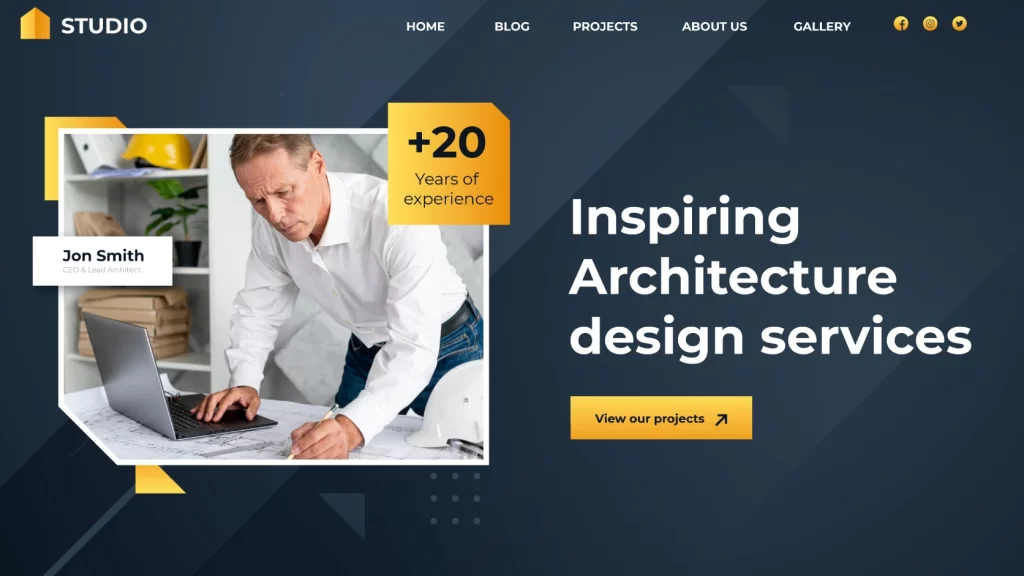
For an architecture firm, the homepage should immediately communicate the firm’s visual identity.
A strong homepage may include:
Hero Section
A large project image or carefully selected visual.
Introduction
A short explanation of the firm’s philosophy.
Featured Projects
Showcase selected projects.
Services
Explain the firm’s key capabilities.
About the Firm
Provide a concise introduction.
Testimonials
Show client experiences where appropriate.
Contact CTA
Make it easy to start a conversation.
The homepage should avoid excessive text above the fold.
Instead, it should create curiosity and encourage visitors to explore the portfolio.
5. Make Project Discovery Easy
Architecture firms may have dozens or hundreds of projects.
If everything appears on one page, visitors can find it difficult to navigate.
A better approach is to organize projects into categories.
For example:
Residential
- Villas
- Apartments
- Private residences
Commercial
- Offices
- Retail
- Corporate buildings
Hospitality
- Hotels
- Resorts
- Restaurants
Institutional
- Schools
- Hospitals
- Public buildings
Interior
- Residential interiors
- Commercial interiors
- Hospitality interiors
Filters can make large portfolios easier to explore.
Visitors could filter projects by:
- Project type
- Location
- Year
- Architecture style
- Sector
6. Optimize the Website for Mobile Users
An architecture firm’s website should look excellent on smartphones as well as desktop computers.
Potential clients may discover the firm through:
- Google Search
- Referrals
- Online directories
- Project publications
Many of these users may initially visit the website from a smartphone.
The mobile experience should therefore include:
- Responsive project galleries
- Easy navigation
- Readable typography
- Touch-friendly controls
- Optimized images
- Fast loading
- Simple enquiry forms
Project images should remain visually strong even when displayed on smaller screens.
7. Create an SEO-Friendly Website Structure
A beautiful portfolio alone does not guarantee organic traffic.
Search engines need useful, indexable content that explains what the architecture firm does.
Important pages can include:
- Architecture services
- Residential architecture
- Commercial architecture
- Interior architecture
- Hospitality architecture
- Sustainable architecture
- Project pages
- Location pages
- About page
- Blog
- Contact page
For example, a firm serving Delhi could create useful content around relevant services rather than simply repeating “architect in Delhi” throughout the website.
Google provides technical guidance through Google Search Central.
8. Build Strong Location-Based Pages
Architecture firms often serve specific cities or regions.
A firm working across India may have projects in:
- Delhi
- Gurgaon
- Noida
- Mumbai
- Bengaluru
- Pune
- Hyderabad
- Kolkata
- Jaipur
Location pages can help communicate where the firm works.
However, every location page should contain genuinely useful information.
A good page could include:
- Projects completed in the city
- Services available
- Local architectural considerations
- Project examples
- Client types
- Contact information
Avoid creating dozens of pages that contain almost identical content with only the city name changed.
9. Focus on Lead Generation
An architecture website should not only showcase projects.
It should also encourage potential clients to contact the firm.
Useful calls to action include:
- Start a Project
- Discuss Your Project
- Request a Consultation
- Book a Consultation
- Enquire Now
- Contact the Architect
- Request a Proposal
The CTA should appear naturally throughout the website.
For example, after a project case study, you can add:
Planning a similar project? Let’s discuss your requirements.
This creates a natural connection between portfolio content and lead generation.
What Pages Should an Architecture Firm Website Have?
A professional architecture website can include the following structure:
| Page | Purpose |
|---|---|
| Home | Introduce the architecture firm |
| About | Explain experience and philosophy |
| Projects | Showcase portfolio |
| Residential | Highlight residential expertise |
| Commercial | Showcase commercial projects |
| Hospitality | Display hospitality work |
| Services | Explain architecture services |
| Case Studies | Provide detailed project stories |
| Blog | Build SEO visibility |
| Testimonials | Build trust |
| Contact | Generate enquiries |
The exact structure should depend on the firm’s services and portfolio.
Architecture Portfolio Website vs Generic Business Website
An architecture website needs to be more visual and project-oriented than a standard business website.
| Feature | Generic Business Website | Architecture Website |
|---|---|---|
| Company information | Yes | Yes |
| Services | Yes | Yes |
| Project portfolio | Optional | Essential |
| High-quality imagery | Useful | Essential |
| Project case studies | Optional | Highly valuable |
| Project filtering | Rare | Useful |
| Design philosophy | Optional | Important |
| Awards | Optional | Useful |
| Location projects | Optional | Important |
| Consultation CTA | Useful | Essential |
| Visual storytelling | Limited | Core feature |
The goal is not to add every possible feature.
Instead, the website should prioritize the features that help potential clients understand the firm’s work and expertise.
How to Present Architecture Projects Online
Project presentation should be treated almost like a digital exhibition.
Start with the strongest image.
Then provide context.
For example:
Project: Contemporary Residence
Location: Gurgaon
Type: Residential
Area: 4,500 sq. ft.
Year: 2026
Then explain:
- Design concept
- Site context
- Material selection
- Spatial planning
- Sustainability considerations
- Client requirements
Follow this with a carefully arranged image gallery.
This approach allows the website to communicate the thinking behind the architecture rather than only displaying finished photographs.
Use Video and Interactive Content Carefully
Architecture websites can benefit from video.
Useful formats include:
- Project walkthroughs
- Drone footage
- Construction progress
- 3D visualization
- Before-and-after transformations
- Architect interviews
However, video files can be large.
Use optimized formats and lazy loading so that multimedia does not negatively affect website performance.
The objective is to enhance the project experience without making the website unnecessarily slow.
Architecture Website Design for Different Firms
Residential Architecture Firms
A residential architecture website can focus on:
- Villas
- Apartments
- Private homes
- Renovations
- Interior architecture
- Sustainable homes
High-quality lifestyle-oriented photography can be particularly useful.
Commercial Architecture Firms
Commercial firms may need pages for:
- Offices
- Retail spaces
- Corporate buildings
- Mixed-use developments
- Business parks
Case studies can explain project scale, planning and business objectives.
Hospitality Architecture Firms
Hospitality projects may include:
- Hotels
- Resorts
- Restaurants
- Cafes
- Boutique properties
The website should communicate atmosphere and guest experience through strong imagery.
Sustainable Architecture Firms
Sustainability-focused practices can highlight:
- Passive design
- Energy efficiency
- Natural ventilation
- Sustainable materials
- Solar integration
- Water management
- Green building practices
This can help differentiate the firm from competitors.
Build Trust Through Credentials and Recognition
Architecture clients often evaluate experience before initiating a project.
Trust-building elements can include:
- Years of experience
- Professional qualifications
- Awards
- Publications
- Completed projects
- Client testimonials
- Certifications
- Industry memberships
- Media coverage
These elements should be presented clearly without overwhelming the website.
A dedicated About page can provide additional information about the firm’s people, philosophy and experience.
Create an Architecture Blog Strategy
A blog can help an architecture firm attract visitors through search engines.
Useful topics could include:
- Modern house design ideas
- Sustainable architecture trends
- How to choose an architect
- Architecture design process
- Residential architecture planning
- Commercial architecture considerations
- Interior architecture ideas
- Green building design
- Cost considerations for architectural projects
- Questions to ask an architect
The content should answer genuine customer questions.
This can help attract potential clients before they are ready to contact the firm.
Technical SEO for Architecture Websites
Architecture websites often contain many images, which makes technical optimization particularly important.
Important areas include:
- Image compression
- Responsive images
- ALT attributes
- Page speed
- Mobile responsiveness
- Internal linking
- XML sitemap
- Clean URLs
- Canonical URLs
- Structured content
- Crawlability
Project pages should have descriptive URLs.
For example:
/projects/contemporary-villa-gurgaon/
is more useful than:
/project/page-123/
The website should also make it easy for search engines to discover project pages through internal links.
How Much Does Architecture Firm Website Development Cost in India?
The cost of an architecture website depends on the complexity of the project.
Factors include:
- Number of pages
- Number of projects
- Custom UI/UX
- Portfolio functionality
- Project filters
- Animation
- Video integration
- CMS
- SEO
- Forms
- Third-party integrations
- Website maintenance
A simple architecture portfolio can have a relatively straightforward structure.
A large architecture firm with hundreds of projects may require advanced filtering, search, project categorization and a custom content management system.
The development budget should therefore be based on requirements rather than simply the number of pages.
How to Choose a Website Development Company for an Architecture Firm
Before hiring a developer or agency, review:
Portfolio Quality
Look for websites that demonstrate strong visual presentation.
Custom Design Capability
Architecture firms often need distinctive layouts rather than generic templates.
WordPress Expertise
If you want to manage projects and blog content internally, WordPress can provide a flexible CMS.
Performance Optimization
Ask how the agency will handle large project images and media.
SEO Knowledge
The agency should understand technical SEO and content structure.
Mobile Experience
Check how the portfolio behaves on smartphones.
Ongoing Support
Understand who will handle updates, changes and technical issues after launch.
Scalability
Make sure new projects can easily be added as the firm grows.
WordPress for Architecture Firm Websites
WordPress can be a useful platform for architecture firms because it allows teams to manage project content without requiring technical knowledge for every update.
A custom WordPress architecture website can include:
- Custom project post types
- Project categories
- Project filters
- Custom galleries
- Location information
- Team profiles
- Blog
- Testimonials
- Contact forms
- SEO tools
For firms requiring more advanced functionality, a WordPress development company in Delhi can create custom website functionality around the firm’s requirements.
Custom WordPress themes can also provide greater control over typography, layouts, animations and portfolio presentation.
Website Performance for Image-Heavy Architecture Websites
Architecture websites often have one major technical challenge: large images.
A single project can contain dozens of high-resolution photographs.
Uploading these images without optimization can significantly increase page size.
A professional development approach should therefore include:
- Proper image dimensions
- Compression
- WebP or modern formats
- Responsive image delivery
- Lazy loading
- Optimized galleries
- Efficient caching
The visual quality should remain high while unnecessary file weight is reduced.
This is particularly important for mobile users.
Internal Linking Strategy
Internal links can help visitors discover related services and also help search engines understand the relationship between pages.
For NJ Technos, relevant internal links can include:
- NJ Technos
- WordPress development company in Delhi
- Website design company in Delhi NCR
- Website redesign services
- Website maintenance services
These should be placed naturally within relevant sections rather than grouped together in one paragraph.
External Resources for Architecture Websites
A few authoritative external resources can support the article.
For SEO and website discoverability, use Google Search Central.
For WordPress development standards and documentation, use WordPress Developer Resources.
For website accessibility guidance, the W3C Web Accessibility Initiative provides useful standards and resources.
These links give readers access to authoritative technical information without distracting from the main article.
Common Architecture Website Mistakes
Using a Generic Template
A generic design may fail to communicate the firm’s unique visual identity.
Too Many Images Without Structure
A large gallery is not automatically a good portfolio.
Projects should be organized and explained.
Huge Unoptimized Images
High-resolution images can make pages slow.
No Project Descriptions
Images alone do not explain the firm’s design approach.
Weak Navigation
Visitors should easily move between projects, services and contact pages.
No Mobile Optimization
A portfolio that looks impressive on desktop but breaks on mobile can create a poor experience.
No Clear CTA
Visitors should know how to start a conversation with the firm.
Ignoring SEO
Beautiful design should be supported by a search-friendly technical structure.
Why Choose NJ Technos for Architecture Website Development?
An architecture website requires a balance between visual presentation, technical performance and business functionality.
NJ Technos can help architecture firms create websites using WordPress and custom development approaches.
Services can include:
- Custom website design
- WordPress development
- Custom WordPress themes
- Custom WordPress plugins
- Portfolio development
- Project galleries
- Responsive website development
- SEO-friendly website structure
- Performance optimization
- Website redesign
- Website maintenance
For businesses that need custom functionality, custom WordPress plugin development can be used to create features beyond standard WordPress functionality.
If the existing website needs a visual or structural upgrade, website redesign services can help modernize the experience.
Frequently Asked Questions
What should an architecture firm website include?
An architecture website should include a strong portfolio, detailed project pages, services, about information, testimonials, contact options and clear calls to action.
Why is portfolio design important for an architecture firm?
The portfolio allows potential clients to evaluate the firm’s design style, experience, project types and quality of work before contacting the firm.
Can WordPress be used for architecture websites?
Yes. WordPress can be customized to create project portfolios, case studies, galleries, service pages, blogs and other architecture website features.
Should every architecture project have its own page?
For important projects, dedicated pages are generally useful because they allow the firm to provide detailed information, images and project context.
Is SEO important for architecture firms?
Yes. SEO can help architecture firms reach people searching for architectural services, project types and architects in specific locations.
How can an architecture website generate leads?
Clear consultation CTAs, project case studies, contact forms, phone numbers, enquiry forms and service pages can help turn website visitors into potential clients.
How much does architecture website design cost in India?
The cost depends on design complexity, number of projects, custom functionality, image galleries, animations, SEO and ongoing maintenance requirements.
How long does it take to build an architecture website?
A basic portfolio website can be developed faster than a large architecture website containing hundreds of projects, advanced filters, custom animations and integrations.
Can an existing architecture website be redesigned?
Yes. A redesign can improve visual presentation, navigation, mobile usability, performance, SEO and conversion opportunities while retaining valuable existing content.
Final Thoughts
A modern architecture website should function as a digital portfolio, business development tool and brand experience.
The right architecture firm website design India strategy combines premium visual presentation with clear navigation, detailed project storytelling, responsive development, SEO and strong lead-generation opportunities.
For architecture firms, every project represents an opportunity to demonstrate expertise.
Instead of simply displaying photographs, a well-designed website can explain the thinking, challenges, materials and solutions behind each project.
Whether you are a residential architect, commercial architecture firm, interior architecture studio or large multidisciplinary practice, your website should reflect the quality and character of your work.
A carefully developed website can help your firm build credibility, attract relevant visitors, showcase its portfolio and generate new project enquiries.