Non-governmental organizations and nonprofit organizations need a strong digital presence to communicate their mission, showcase their work and connect with supporters. A professional NGO website design company in India can help create a website that presents an organization’s projects, impact, donation options, volunteer opportunities and contact information in a clear and trustworthy way.
Table of Contents
For an NGO, a website is more than an online brochure. It can become a central platform for fundraising, awareness, volunteer recruitment, community engagement and reporting.
Whether you operate a small local NGO, charitable trust, social organization or large nonprofit working across India, the website should communicate your purpose while making it easy for visitors to take action.
Why Does an NGO Need a Professional Website?
An NGO may interact with many different audiences.
These can include:
- Donors
- Volunteers
- Beneficiaries
- Corporate partners
- Government organizations
- Supporters
- Journalists
- Researchers
- Community members
Each audience may visit the website for a different reason.
A donor may want to understand how contributions are used.
A volunteer may want to register for an upcoming activity.
A corporate organization may want to explore CSR partnerships.
A beneficiary may need information about available programs.
The website should therefore provide clear paths for different types of visitors.
NGO Website Design Company in India: What Should the Website Include?
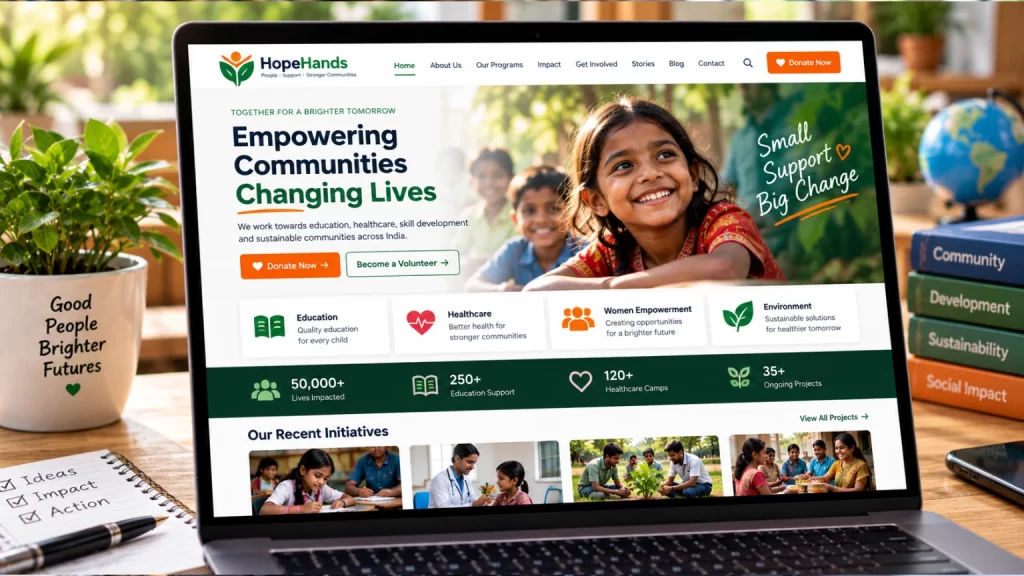
A professional NGO website can include:
- Mission and vision
- About the organization
- Programs
- Projects
- Impact stories
- Donation options
- Volunteer registration
- Events
- Testimonials
- Annual reports
- Financial information
- CSR partnerships
- Blog or news
- Contact information
The exact structure depends on the NGO’s activities and audience.
The most important objective is to make the organization’s work understandable and trustworthy.
9 Powerful Features for NGO Website Design
1. Create a Strong Mission-Focused Homepage
The homepage should communicate the organization’s purpose immediately.
A visitor should quickly understand:
Who are you?
What problem do you address?
Who do you help?
What impact do you create?
How can I help?
A strong NGO homepage can include:
- Mission statement
- Hero image
- Key programs
- Impact statistics
- Featured stories
- Donation CTA
- Volunteer CTA
- Recent projects
- Testimonials
The homepage should avoid overwhelming visitors with too much information.
Instead, it should guide them toward the organization’s most important actions.
2. Showcase Projects and Social Impact
Visitors want to understand what the NGO actually does.
A dedicated project section can showcase initiatives such as:
- Education
- Healthcare
- Women’s empowerment
- Child welfare
- Rural development
- Environmental protection
- Skill development
- Food distribution
- Animal welfare
- Community development
Each project can have its own page.
A project page can explain:
- Project objective
- Location
- Target community
- Activities
- Duration
- Number of beneficiaries
- Project outcomes
- Photos
- Videos
- Impact stories
This transforms the website from a simple information page into a platform that demonstrates real-world work.
3. Add a Secure Online Donation System
For many NGOs, donations are an important part of fundraising.
The website should make donating straightforward.
A donation section can provide:
- Donation amount
- One-time donation
- Recurring donation
- Donor information
- Payment options
- Donation purpose
- Confirmation
- Receipt information
Depending on the organization’s requirements, payment gateways can support online contributions.
The donation CTA should be visible without becoming intrusive.
For example:
Donate Now
Support Education
Help a Child
Support Our Healthcare Program
Specific donation campaigns can make it easier for visitors to understand where their contribution may be directed.
4. Build a Volunteer Registration System
Many NGOs depend on volunteers.
A website can make volunteer registration easier through an online form.
The form can collect:
- Name
- Phone
- Location
- Skills
- Area of interest
- Availability
- Preferred activity
- Message
The NGO can then review registrations from an administrative dashboard.
Volunteer opportunities can also be displayed on a dedicated page.
For example:
Teaching Volunteer
Event Volunteer
Fundraising Volunteer
Community Outreach
Social Media Volunteer
This gives visitors clear ways to participate beyond financial donations.
5. Build Trust Through Transparency
Trust is particularly important for nonprofit organizations.
Potential donors may want to understand how the organization operates and where its work is taking place.
The website can provide:
- Annual reports
- Impact reports
- Financial information
- Registration details
- Organization information
- Project updates
- Partner information
- Testimonials
- News coverage
Important legal and financial information should be presented accurately according to the organization’s actual registrations and reporting obligations.
Transparency can make the website more informative for donors, partners and supporters.
6. Use Real Stories and Visual Content
People connect with stories.
An NGO website can showcase:
- Beneficiary stories
- Volunteer experiences
- Project stories
- Community stories
- Before-and-after initiatives
- Field activities
Photography and video can make these stories more engaging.
For example:
Before
A community has limited access to educational resources.
Initiative
The NGO establishes a local learning center.
Progress
Students receive educational support.
Impact
The program reaches a defined number of students.
This structure helps visitors understand the organization’s work more clearly.
7. Make the Website Mobile-Friendly
Many users may discover an NGO through social media, messaging platforms or search engines on smartphones.
The website should therefore work well on mobile devices.
Important features include:
- Responsive design
- Easy navigation
- Mobile-friendly donation forms
- Click-to-call
- WhatsApp/contact options where appropriate
- Fast image loading
- Readable text
- Simple volunteer forms
A visitor should be able to donate or register as a volunteer without struggling with the mobile interface.
8. Optimize the Website for Search Engines
NGOs can attract organic traffic through searches related to their causes and programs.
Potential topics include:
- NGO for child education
- NGO for rural development
- NGO for women’s empowerment
- Education NGO India
- Healthcare NGO India
- Environmental NGO India
- NGO volunteering opportunities
- Donate to education programs
The website should have dedicated pages for important programs rather than trying to rank one homepage for every topic.
Google provides technical SEO guidance through Google Search Central.
Content should be created for users first and optimized naturally for relevant search queries.
9. Create Clear Calls to Action
An NGO website should always give visitors a clear next step.
Useful CTAs include:
Donate Now
Become a Volunteer
Support Our Mission
Partner With Us
Join Our Campaign
Contact Us
Learn About Our Projects
Different visitors may respond to different actions.
A donor may click Donate Now, while someone who wants to contribute their time may choose Volunteer.
NGO Website Structure
A useful NGO website structure can look like this:
| Page | Purpose |
|---|---|
| Home | Introduce the organization |
| About Us | Explain mission and history |
| Our Programs | Explain areas of work |
| Projects | Showcase initiatives |
| Impact | Demonstrate results |
| Donate | Accept contributions |
| Volunteer | Recruit volunteers |
| Events | Promote activities |
| Stories | Share real experiences |
| Reports | Provide transparency |
| Blog/News | Publish updates |
| Contact | Enable communication |
This structure can be customized according to the NGO’s activities.
NGO Website Design for Different Causes
Different nonprofit organizations require different website structures.
Education NGOs
Education-focused organizations can showcase:
- Schools
- Scholarships
- Learning centers
- Digital education
- Teacher training
- Student stories
Healthcare NGOs
Healthcare organizations may highlight:
- Medical camps
- Health awareness
- Treatment programs
- Community healthcare
- Patient support
Women Empowerment NGOs
These organizations can showcase:
- Skill development
- Employment programs
- Entrepreneurship
- Education
- Community initiatives
Environmental NGOs
Environmental organizations can highlight:
- Tree plantation
- Conservation
- Waste management
- Climate awareness
- Sustainability projects
Child Welfare NGOs
Child-focused organizations may showcase:
- Education
- Nutrition
- Healthcare
- Child protection
- Community support
The website should reflect the actual work of the organization rather than using a generic nonprofit structure.
NGO Donation Website Design
Donation pages should be simple and focused.
A good donation page can explain:
What Your Donation Supports
For example:
₹500 → Educational materials
₹1,000 → Community support
₹2,500 → Program contribution
The exact examples should always reflect the NGO’s actual programs and financial model.
The page can also explain:
- Payment methods
- Donation process
- Receipt process
- Contact information
- Relevant policies
Avoid making unsupported claims about exactly how every individual donation is allocated.
CSR Partnership Section
Corporate partnerships can be important for NGOs.
A dedicated CSR page can explain:
- Organization’s mission
- Projects
- Geographic reach
- Impact
- Partnership opportunities
- Reporting
- Contact details
Potential partnership formats can include:
- Education programs
- Healthcare initiatives
- Skill development
- Environmental projects
- Community development
The NGO can provide a downloadable partnership document or enquiry form.
NGO Volunteer Website Features
Volunteer recruitment can be improved through a dedicated system.
A volunteer page can display:
Current Opportunities
- Teaching
- Fundraising
- Events
- Community outreach
- Digital support
Each opportunity can explain:
- Responsibilities
- Location
- Time commitment
- Required skills
- Application process
This gives potential volunteers enough information before they apply.
NGO Events and Campaigns
NGOs often organize:
- Awareness campaigns
- Fundraising events
- Workshops
- Medical camps
- Community events
- Training programs
An events section can display:
- Event title
- Date
- Location
- Description
- Registration
- Photos
- Results
After an event, the page can be updated with photographs and an impact summary.
This creates a useful archive of the organization’s activities.
NGO Website and Social Media Integration
NGOs often use social media to reach supporters.
The website can connect with:
- YouTube
For example:
Social Media Post
↓
Website Project Page
↓
Impact Story
↓
Donate / Volunteer
This gives social traffic a clear destination.
The website should remain the organization’s central source of detailed information rather than depending entirely on third-party social platforms.
Transparency and Annual Reports
Annual reports can provide useful information about the organization’s activities.
A reports section can include:
- Annual reports
- Impact reports
- Program updates
- Financial reports where appropriate
- Publications
- Newsletters
Documents should be clearly labeled by year.
For example:
Annual Report 2025–26
Annual Report 2024–25
This makes it easier for donors and partners to understand the organization’s history.
NGO Website Accessibility
An NGO website should be usable by people with different abilities.
Important considerations include:
- Keyboard navigation
- Accessible forms
- Readable typography
- Good color contrast
- Alternative text
- Clear button labels
- Accessible navigation
The W3C Web Accessibility Initiative provides useful accessibility guidance.
Accessibility is especially relevant for organizations serving diverse communities.
WordPress for NGO Website Development
WordPress can be a practical platform for many NGOs because staff members can update projects, stories, events and other content without requiring technical knowledge for every change.
A custom WordPress NGO website can include:
- Custom project post types
- Program categories
- Donation forms
- Volunteer forms
- Event management
- Blog
- Impact stories
- Team profiles
- Reports
- Testimonials
For organizations requiring a customized platform, a WordPress development company in Delhi can develop features around the NGO’s specific requirements.
Custom Plugin Development for NGO Websites
Some NGOs require functionality beyond standard website features.
Custom plugin development can support:
- Donation management
- Volunteer registration
- Beneficiary management
- Project management
- Campaign management
- Event registration
- Custom dashboards
- Reports
- CRM integrations
For specialized requirements, custom WordPress plugin development can provide functionality tailored to the organization’s workflow.
NGO Website Performance
NGO websites often contain many photographs and videos from field activities.
Large media files can make pages slow.
Performance optimization can include:
- Image compression
- WebP images
- Responsive images
- Lazy loading
- Video optimization
- Caching
- Efficient CSS
- Efficient JavaScript
The goal is to preserve the emotional and visual quality of the website without making it unnecessarily heavy.
SEO Content Strategy for NGOs
An NGO blog can help attract people interested in the organization’s cause.
Possible content topics include:
- Importance of education
- Community development
- Women’s empowerment
- Child education
- Healthcare awareness
- Environmental conservation
- Volunteer opportunities
- NGO impact stories
- Community success stories
Content should focus on genuine knowledge and experiences.
For example, an education NGO can publish articles about educational challenges, program outcomes and community initiatives.
How Much Does NGO Website Development Cost in India?
There is no fixed cost for an NGO website.
The budget depends on the required functionality.
Factors include:
- Number of pages
- Custom design
- Project management
- Donation system
- Payment gateway
- Volunteer registration
- Events
- Reports
- Blog
- CRM integration
- Custom dashboard
- SEO
- Content migration
- Maintenance
A simple informational NGO website will have different requirements from a large platform with donations, volunteer management and multiple program dashboards.
The project scope should therefore be defined before comparing development proposals.
NGOs looking for a reliable technology partner can explore NJ Technos for customized website development solutions.
How to Choose an NGO Website Design Company in India
Before hiring an agency, evaluate:
Portfolio
Review previous nonprofit or mission-driven websites.
Custom Design
The website should communicate the organization’s unique identity.
Donation Experience
Test how easy it is to find and complete a donation.
Mobile Experience
Check the website on smartphones.
SEO
Make sure the website has a search-friendly structure.
Security
Donation forms and user information need appropriate protection.
Content Management
Staff should be able to update projects, events and stories.
Ongoing Support
Ask about maintenance, updates and troubleshooting after launch.
NGOs can also follow Google Search Central to understand Google’s guidance for making websites easier to discover in search.
Common NGO Website Mistakes
Making the Website Too Generic
The organization’s mission should be immediately clear.
Hiding the Donation Button
Visitors should not have to search for donation information.
Not Showing Impact
Explain what the organization actually does.
Using Only Stock Images
Real project photography can communicate authenticity when appropriate and used with proper consent.
Ignoring Mobile Users
Donation and volunteer forms must work well on smartphones.
No Transparency Section
Relevant reports and organization information should be easy to find.
Slow Images
Large field photographs can affect page performance.
No Clear CTA
Every major page should provide an appropriate next action
Why Choose NJ Technos for NGO Website Design?
An NGO website needs to communicate purpose, impact and trust while providing practical tools for donors, volunteers and supporters.
NJ Technos can help NGOs create customized websites with:
- NGO website design
- WordPress development
- Custom themes
- Custom plugins
- Donation forms
- Volunteer registration
- Project management
- Event management
- Impact stories
- SEO-friendly development
- Performance optimization
- Website maintenance
For organizations requiring specialized functionality, custom WordPress plugin development can be used to create features around specific operational requirements.
For ongoing technical support, website maintenance services can help with updates, security and performance.
Frequently Asked Questions
What should an NGO website include?
An NGO website should typically include information about the organization, mission, programs, projects, impact, donation options, volunteer opportunities, reports and contact information.
Why does an NGO need a professional website?
A professional website can help an NGO communicate its work, build an online presence, attract donors, recruit volunteers and provide information to supporters.
Can an NGO accept donations through its website?
Yes. An NGO can integrate suitable online payment solutions where legally and operationally appropriate.
Can an NGO website have volunteer registration?
Yes. A custom registration form can collect volunteer information and help the organization manage applications.
Can an NGO website showcase projects?
Yes. Dedicated project pages can showcase initiatives, locations, activities, photographs, outcomes and impact stories.
Can WordPress be used for an NGO website?
Yes. WordPress can support pages, projects, blogs, events, forms and custom functionality. More specialized requirements may require custom development.
Is SEO important for NGO websites?
SEO can help people discover an organization’s programs, causes, resources and volunteer opportunities through search engines.
How much does NGO website design cost in India?
The cost depends on the website’s design, number of pages, donation functionality, forms, integrations, custom development and ongoing maintenance.
Can an existing NGO website be redesigned?
Yes. A redesign can improve the website’s visual presentation, mobile experience, navigation, performance, SEO and conversion opportunities.
Final Thoughts
An NGO website should do more than explain what an organization does.
It should create a clear digital connection between the organization and its donors, volunteers, beneficiaries, partners and supporters.
The right NGO website design company in India can help create a website that combines strong visual storytelling with transparent information, project showcases, donation functionality, volunteer registration and mobile-friendly design.
A well-structured website can make it easier for visitors to understand the organization’s mission and decide how they want to participate.
Whether you are a small nonprofit, charitable trust, community organization or established NGO, the website should be designed around your actual goals, audience and programs.